Representativeness, qual & quant, and Big Data. Lost in translation?

My biggest challenge in coming from a quantitative background to a qualitative research program was representativeness. I came to class firmly rooted in the principle of Representativeness, and my classmates seemed not to have any idea why it mattered so much to me. Time after time I would get caught up in my data selection. I would pose the wider challenge of representativeness to a colleague, and they would ask “representative of what? why?”


In the survey research world, the researcher begins with a population of interest and finds a way to collect a representative sample of the population for study. In the qualitative world that accompanies survey research units of analysis are generally people, and people are chosen for their representativeness. Representativeness is often constructed by demographic characteristics. If you’ve read this blog before, you know of my issues with demographics. Too often, demographic variables are used as a knee jerk variable instead of better considered variables that are more relevant to the analysis at hand. (Maybe the census collects gender and not program availability, for example, but just because a variable is available and somewhat correlated doesn’t mean that it is in fact a relevant variable, especially when the focus of study is a population for whom gender is such an integral societal difference.)


And yet I spent a whole semester studying 5 minutes of conversation between 4 people. What was that representative of? Nothing but itself. It couldn’t have been exchanged for any other 5 minutes of conversation. It was simply a conversation that this group had and forgot. But over the course of the semester, this piece of conversation taught me countless aspects of conversation research. Every time I delved back into the data, it became richer. It was my first step into the world of microanalysis, where I discovered that just about anything can be a rich dataset if you use it carefully. A snapshot of people at a lecture? Well, how are their bodies oriented? A snapshot of video? A treasure trove of gestures and facial expressions. A piece of graffiti? Semiotic analysis! It goes on. The world of microanalysis is built on the practice of layered noticing. It goes deeper than wide.


But what is it representative of? How could a conversation be representative? Would I need to collect more conversations, but restrict the participants? Collect conversations with more participants, but in similar contexts? How much or how many would be enough?


In the world of microanalysis, people and objects constantly create and recreate themselves. You consistently create and recreate yourself, but your recreations generally fall into a similar range that makes you different from your neighbors. There are big themes in small moments. But what are the small moments representative of? Themselves. Simply, plainly, nothing more and nothing else. Does that mean that they don’t matter? I would argue that there is no better way to understand the world around us in deep detail than through microanalysis. I would also argue that macroanalysis is an important part of discovering the wider patterns in the world around us.


Recently a NY Times blog post by Quentin Hardy has garnered quite a bit of attention.

Why Big Data is Not Truth: http://bits.blogs.nytimes.com/2013/06/01/why-big-data-is-not-truth/

This post has really struck a chord with me, because I have had a hard time understanding Hardy’s complaint. Is big data truth? Is any data truth? All data is what it is; a collection of some sort, collected under a specific set of circumstances. Even data that we hope to be more representative has sampling and contextual limitations. Responsible analysts should always be upfront about what their data represents. Is big data less truthful than other kinds of data? It may be less representative than, say, a systematically collected political poll. But it is what it is: different data, collected under different circumstances in a different way. It shouldn’t be equated with other data that was collected differently. One true weakness of many large scale analyses is the blindness to the nature of the data, but that is a byproduct of the training algorithms that are used for much of the analysis. The algorithms need large training datasets, from anywhere. These sets often are developed through massive web crawlers. Here, context gets dicey. How does a researcher represent the data properly when they have no idea what it is? Hopefully researchers in this context will be wholly aware that, although their data has certain uses, it also has certain [huge] limitations.


I suspect that Hardy’s complaint is with the representations of massive datasets collected from webcrawlers as a complete truth from which any analyses could be run and all of the greater truths of the world could be revealed. On this note, Hardy is exactly right. Data simply is what it is, nothing more and nothing less. And any analysis that focuses on an unknown dataset is just that: an analysis without context. Which is not to say that all analyses need to be representative, but rather that all responsible analyses of good quality need to be self aware. If you do not know what the data represents and when and how it was collected, then you cannot begin to discuss the usefulness of any analysis of it.

The curse of the elevator speech

Yesterday I was involved in an innocent watercooler chat in which I was asked what Sociolinguistics is. This should be an easy enough question, because I just got a master’s degree in it. But it’s not. Sociolinguistics is a large field that means different things to different people. For every way of studying language, there are social and behavioral correlates that can also be studied. So a sociolinguist could focus on any number of linguistic areas, including phonology, syntax, semantics, or, in my case, discourse. My studies focus on the ways in which people use language, and the units of analysis in my studies are above the sentence level. Because Linguistics is such a large and siloed field, explaining Sociolinguistics through the lens of discourse analysis feels a bit like explaining vegetarianism through a pescatarian lens. The real vegetarians and the real linguists would balk.

There was a follow up question at the water cooler about y’all. “Is it a Southern thing?” My answer to this was so admittedly lame that I’ve been trying to think of a better one (sometimes even the most casual conversations linger, don’t they?).

My favorite quote of this past semester was from Jan Blommaert: “Language reflects a life, and not just a birth, and it is a life that is lived in a real sociocultural, historical and political space” Y’all has long been considered a southernism, but when I think back to my own experience with it, it was never about southern language or southern identity. One big clue to this is that I do sometimes use y’all, but I don’t use other southern language features along with it.

If I wanted to further investigate y’all from a sociolinguistic perspective, I would take language samples, either from one or a variety of speakers (and this sampling would have clear, meaningful consequences) and track the uses of y’all to see when it was invoked and what function it serves when invoked. My best, uninformed guess is that it does relational work and invokes registers that are more casual and nonthreatening. But without data, that is nothing but an uninformed guess.

This work has likely been done before. It would be interesting to see.
(ETA: Here is an example of this kind of work in action, by Barbara Johnstone)

What is the role of Ethnography and Microanalysis in Online Research?

There is a large disconnect in online research.

The largest, most profile, highest value and most widely practiced side of online research was created out of a high demand to analyze the large amount of consumer data that is constantly being created and largely public available. This tremendous demand led to research methods that were created in relative haste. Math and programming skills thrived in a realm where social science barely made a whisper. The notion of atheoretical research grew. The level of programming and mathematical competence required to do this work continues to grow higher every day, as the fields of data science and machine learning become continually more nuanced.

The largest, low profile, lowest value and increasingly more practiced side of online research is the academic research. Turning academia toward online research has been like turning a massive ocean liner. For a while online research was not well respected. At this point it is increasingly well respected, thriving in a variety of fields and in a much needed interdisciplinary way, and driven by a search for a better understanding of online behavior and better theories to drive analyses.

I see great value in the intersection between these areas. I imagine that the best programmers have a big appetite for any theory they can use to drive their work in a useful and productive ways. But I don’t see this value coming to bear on the market. Hiring is almost universally focused on programmers and data scientists, and the microanalytic work that is done seems largely invisible to the larger entities out there.

It is common to consider quantitative and qualitative research methods as two separate languages with few bilinguals. At the AAPOR conference in Boston last week, Paul Lavarakas mentioned a book he is working on with Margaret Roller which expands the Total Survey Error model to both quantitative and qualitative research methodology. I spoke with Margaret Roller about the book, and she emphasized the importance of qualitative researchers being able to talk more fluently and openly about methodology and quality controls. I believe that this is, albeit a huge challenge in wording and framing, a very important step for qualitative research, in part because quality frameworks lend credibility to qualitative research in the eyes of a wider research community. I wish this book a great deal of success, and I hope that it is able to find an audience and a frame outside the realm of survey research (Although survey research has a great deal of foundational research, it is not well known outside of the field, and this book will merit a wider audience).

But outside of this book, I’m not quite sure where or how the work of bringing these two distinct areas of research can or will be done.

Also at the AAPOR conference last week, I participated in a panel on The Role of Blogs in Public Opinion Research (intro here and summary here). Blogs serve a special purpose in the field of research. Academic research is foundational and important, but the publish rate on papers is low, and the burden of proof is high. Articles that are published are crafted as an argument. But what of the bumps along the road? The meditations on methodology that arise? Blogs provide a way for researchers to work through challenges and to publish their failures. They provide an experimental space where fields and ideas can come together that previously hadn’t mixed. They provide a space for finding, testing, and crossing boundaries.

Beyond this, they are a vehicle for dissemination. They are accessible and informally advertised. The time frame to publish is short, the burden lower (although I’d like to believe that you have to earn your audience with your words). They are a public face to research.

I hope that we will continue to test these boundaries, to cross over barriers like quantitative and qualitative that are unhelpful and obtrusive. I hope that we will be able to see that we all need each other as researchers, and the quality research that we all want to work for will only be achieved through the mutual recognition that we need.

Revisiting Latino/a identity using Census data

On April 10, I attended a talk by Jennifer Leeman (Research Sociolinguist @Census and Assistant Professor @George Mason) entitled “Spanish and Latino/a identity in the US Census.” This was a great talk. I’ll include the abstract below, but here are some of her main points:

  • Census categories promote and legitimize certain understandings, particularly because the Census, as a tool of the government, has an appearance of neutrality
  • Census must use categories from OMB
  • The distinction between race and ethnicity is fuzzy and full of history.
    • o   In the past, this category has been measured by surname, mothertongue, birthplace
      o   Treated as hereditary (“perpetual foreigner” status)
      o   Self-id new, before interviewer would judge, record
  • In the interview context, macro & micro meet
    • o   Macro level demographic categories
    • o   Micro:
      • Interactional participant roles
      • Indexed through labels & structure
      • Ascribed vs claimed identities
  • The study: 117 telephone interviews in Spanish
    • o   2 questions, ethnicity & race
    • o   Ethnicity includes Hispano, Latino, Español
      • Intended as synonyms but treated as a choice by respondents
      • Different categories than English (Adaptive design at work!)
  • The interviewers played a big role in the elicitation
    • o   Some interviewers emphasized standardization
      • This method functions differently in different conversational contexts
    • o   Some interviewers provided “teaching moments” or on-the-fly definitions
      • Official discourses mediated through interviewer ideologies
      • Definitions vary
  • Race question also problematic
    • o   Different conceptions of Indioamericana
      • Central, South or North American?
  • Role of language
    • o   Assumption of monolinguality problematic, bilingual and multilingual quite common, partial and mixed language resources
    • o   “White” spoken in English different from “white” spoken in Spanish
    • o   Length of time in country, generation in country belies fluid borders
  • Coding process
    • o   Coding responses such as “American, born here”
    • o   ~40% Latino say “other”
    • o   Other category ~ 90% Hispanic (after recoding)
  • So:
    • o   Likely result: one “check all that apply” question
      • People don’t read help texts
    • o   Inherent belief that there is an ideal question out there with “all the right categories”
      • Leeman is not yet ready to believe this
    • o   The takeaway for survey researchers:
      • Carefully consider what you’re asking, how you’re asking it and what information you’re trying to collect
  • See also Pew Hispanic Center report on Latino/a identity


 ABSTRACT

Censuses play a crucial role in the institutionalization and circulation of specific constructions of national identity, national belonging, and social difference, and they are a key site for the production and institutionalization of racial discourse (Anderson 1991; Kertzer & Arel 2002; Nobles 2000; Urla 1994).  With the recent growth in the Latina/o population, there has been increased interest in the official construction of the “Hispanic/Latino/Spanish origin” category (e.g., Rodriguez 2000; Rumbaut 2006; Haney López 2005).  However, the role of language in ethnoracial classification has been largely overlooked (Leeman 2004). So too, little attention has been paid to the processes by which the official classifications become public understandings of ethnoracial difference, or to the ways in which immigrants are interpellated into new racial subjectivities.

This presentation addresses these gaps by examining the ideological role of Spanish in the history of US Census Bureau’s classifications of Latina/os as well as in the official construction of the current “Hispanic/Latino/Spanish origin” category. Further, in order to gain a better understanding of the role of the census-taking in the production of new subjectivities, I analyze Spanish-language telephone interviews conducted as part of Census 2010.  Insights from recent sociocultural research on the language and identity (Bucholtz and Hall 2005) inform my analysis of how racial identities are instantiated and negotiated, and how respondents alternatively resist and take up the identities ascribed to them.

* Dr. Leeman is a Department of Spanish & Portuguese Graduate (GSAS 2000).

Digital Democracy Remixed

I recently transitioned from my study of the many reasons why the voice of DC taxi drivers is largely absent from online discussions into a study of the powerful voice of the Kenyan people in shaping their political narrative using social media. I discovered a few interesting things about digital democracy and social media research along the way, and the contrast between the groups was particularly useful.

Here are some key points:

  • The methods of sensemaking that journalists use in social media is similar to other methods of social media research, except for a few key factors, the most important of which is that the bar for verification is higher
  • The search for identifiable news sources is important to journalists and stands in contrast with research methods that are built on anonymity. This means that the input that journalists will ultimately use will be on a smaller scale than the automated analyses of large datasets widely used in social media research.
  • The ultimate information sources for journalists will be small, but the phenomena that will capture their attention will likely be big. Although journalists need to dig deep into information, something in the large expanse of social media conversation must capture or flag their initial attention
  • It takes some social media savvy to catch the attention of journalists. This social media savvy outweighs linguistic correctness in the ultimate process of getting noticed. Journalists act as intermediaries between social media participants and a larger public audience, and part of the intermediary process is language correcting.
  • Social media savvy is not just about being online. It is about participating in social media platforms in a publicly accessible way in regards to publicly relevant topics and using the patterned dialogic conventions of the platform on a scale that can ultimately draw attention. Many people and publics go online but do not do this.

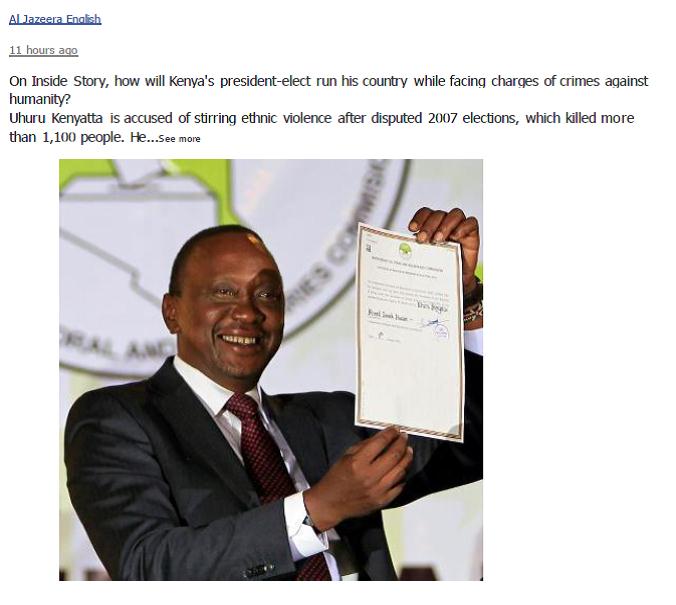
The analysis of social media data for this project was particularly interesting. My data source was the comments following this posting on the Al Jazeera English Facebook feed.

fb

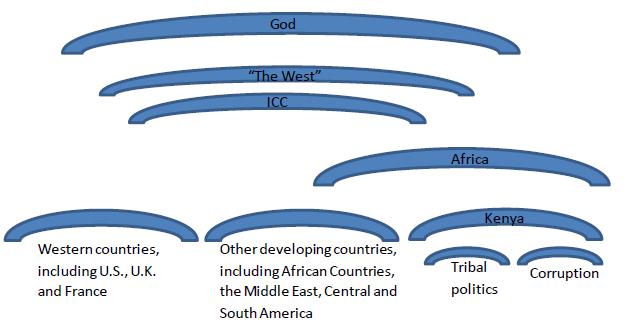
It evolved quite organically. After a number of rounds of coding I noticed that I kept drawing diagrams in the margins of some of the comments. I combined the diagrams into this framework:

scales

Once this framework was built, I looked closely at the ways in which participants used this framework. Sometimes participants made distinct discursive moves between these levels. But when I tried to map the participants’ movements on their individual diagrams, I noticed that my depictions of their movements rarely matched when I returned to a diagram. Although my coding of the framework was very reliable, my coding of the movements was not at all. This led me to notice that oftentimes the frames were being used more indexically. Participants were indexing levels of the frame, and this indexical process created powerful frame shifts. So, on the level of Kenyan politics exclusively, Uhuru’s crimes had one meaning. But juxtaposed against the crimes of other national leaders’ Uhuru’s crimes had a dramatically different meaning. Similarly, when the legitimacy of the ICC was questioned, the charges took on a dramatically different meaning. When Uhuru’s crimes were embedded in the postcolonial East vs West dynamic, they shrunk to the degree that the indictments seemed petty and hypocritical. And, ultimately, when religion was invoked the persecution of one man seemed wholly irrelevant and sacrilegious.

These powerful frame shifts enable the Kenyan public to have a powerful, narrative changing voice in social media. And their social media savvy enables them to gain the attention of media sources that amplify their voices and thus redefine their public narrative.

readyforcnn

Instagram is changing the way I see

I recently joined Instagram (I’m late, I know).

I joined because my daughter wanted to, because her friends had, to see what it was all about. She is artistic, and we like to talk about things like color combinations and camera angles, so Instagram is a good fit for us. But it’s quickly changing the way I understand photography. I’ve always been able to set up a good shot, and I’ve always had an eye for color. But I’ve never seriously followed up on any of it. It didn’t take long on Instagram to learn that an eye for framing and color is not enough to make for anything more than accidental great shots. The great shots that I see are the ones that pick deeper patterns or unexpected contrasts out of seemingly ordinary surroundings. They don’t simply capture beauty, they capture an unexpected natural order or a surprising contrast, or they tell a story. They make you gasp or they make you wonder. They share a vision, a moment, an insight. They’re like the beginning paragraph of a novel or the sketch outline of a poem. Realizing that, I have learned that capturing the obvious beauty around me is not enough. To find the good shots, I’ll need to leave my comfort zone, to feel or notice differently, to wonder what or who belongs in a space and what or who doesn’t, and why any of it would capture anyone’s interest. It’s not enough to see a door. I have to wonder what’s behind it. To my surprise, Instagram has taught me how to think like a writer again, how to find hidden narratives, how to feel contrast again.

Sure this makes for a pretty picture. But what is unexpected about it? Who belongs in this space? Who doesn't? What would catch your eye?

Sure this makes for a pretty picture. But what is unexpected about it? Who belongs in this space? Who doesn’t? What would catch your eye?

This kind of change has a great value, of course, for a social media researcher. The kinds of connections that people forge on social media, the different ways in which people use platforms and the ways in which platforms shape the way we interact with the world around us, both virtual and real, are vitally important elements in the research process. In order to create valid, useful research in social media, the methods and thinking of the researcher have to follow closely with the methods and thinking of the users. If your sensemaking process imitates the sensemaking process of the users, you know that you’re working in the right direction, but if you ignore the behaviors and goals of the users, you have likely missed the point altogether. (For example, if you think of Twitter hashtags simply as an organizational scheme, you’ve missed the strategic, ironic, insightful and often humorous ways in which people use hashtags. Or if you think that hashtags naturally fall into specific patterns, you’re missing their dialogic nature.)

My current research involves the cycle between social media and journalism, and it runs across platforms. I am asking questions like ‘what gets picked up by reporters and why?’ and ‘what is designed for reporters to pick up?’ And some of these questions lead me to examine the differences between funny memes that circulate like wildfire through Twitter leading to trends and a wider stage and the more indepth conversation on public facebook pages, which cannot trend as easily and is far less punchy and digestible. What role does each play in the political process and in constituting news?

Of course, my current research asks more questions than these, but it’s currently under construction. I’d rather not invite you into the workzone until some of the pulp and debris have been swept aside…

Encouraging things I tell myself

Long time, no blog…

Life is currently kicked into overdrive, and I’m switching between coasting and gunning. I know that many of you are also working particularly hard, between the end of the school year, upcoming conferences, taxes, … I’ve thought about using this blog to vent or to catalog my stress (this works better as a to-do list than engaging narrative), to pay tribute to my mom (who passed away May 5, 2012, after spending April living it up on a cruise with her sister), or to wax poetic about my current research project (I will share about the research soon, because I’m really excited about the work I will soon be able to do. But I’m not ready yet.). Instead, I’ve decided to share the encouraging things I tell myself…

Microfocus. This is the true key to a busy lifestyle. Focus on as few things as possible and work to make them happen. Then keep it moving. Thinking big=stress. Thinking small=achievable goals.

Let go of what you can. Put the things that can wait aside. Doing everything all the time is foolish and unnecessary.

Look beyond yourself. Putting all of the burdens on your own shoulders helps no one. It’s not about you. Think to the bigger goal and share your burden.

Know stillness. All of this activity requires some inactivity. Somethings are better for this than others. Throwing caution to the wind and going to sleep when you’re tired is far more effective than reaching for a drink. For me, sleep, nature, exercise and art are the biggest sources of peace. I’ve even started going to church!

Stop fighting. This one really hit me over the head this week. Momentum can lead you to crazy places, where you’re working too hard on too many fronts. But if you take a minute to look around, you may see that all of that frenzy is unnecessary. You’ve been working hard. You’ve put your projects in motion. They have momentum, and they don’t need so much pushing. Getting a degree takes years. You’ve already put in a few. The wheels are already in motion. Don’t push, just follow.

Learning is not supposed to be a done deal. I am about to finish my graduate program next month, and I feel anxious about it. I’m aware of so much that I still don’t know. I catch myself reading Blommaert and worrying that as much as I dig it, I wouldn’t read it on my own. But learning is and has always been a process and a passion. Curiosity drives you to learn. Let that curiosity and passion continue to drive you to grow. The world is bigger than you. You will learn what you need to when you need to, and you will ask for help from the right places when you need to do that.

Be a little emotional. It’s ok to feel happy when things are finished, proud of the hard work you’ve put in, and sad that your mom’s not here to see things come together. And it’s not helpful to worry about feeling anxious!

In a little over a month, many of the pieces I am juggling will come together, and I will have less hanging over me than I’ve had in years. But that point is quite a few deadlines away. For now, I am at bat, focusing on the ball, connecting, and! Next. For those of you who are stressed, I wish you pockets of peace. For those of you who are graduating, “job well done! way to go!” (<– and put a congratulations in your pocket, for when you’re ready to hear it). For those of you who are grieving, I wish you all the ups and downs that go along with it. And for those of you dealing with all of the administrative headaches that accompany loss, I wish you a pat on the back, a quiet beach, a gentle breeze, a margarita, a memory that makes you smile, and some space to cry and scream a little! As they say “this too shall pass.”

Time moves through the jungle, and we swing between vines, focusing on the flowers. I wish you all flowers.

Flower market in Amsterdam

Flower market in Amsterdam

Still grappling with demographics

Last year I wrote about my changing perspective on demographic variables. My grappling has continued since then.
I think of it as an academic puberty of sorts.

I remember the many crazy thought exercises I subjected myself to as a teenager, as I tried to forge my own set of beliefs and my own place in the world. I questioned everything. At times I was under so much construction that it was a wonder I functioned at all. Thankfully, I survived to enter my twenties intact. But lately I have been caught in a similar thought exercise of sorts, second guessing the use of sociological demographic variables in research.

Two sample projects mark two sides of the argument. One is a potential study of the climate for underrepresented faculty members in physics departments. In our exploration of this subject, the meaning of underrepresented was raised. Indeed there are a number of ways in which a faculty member could be underrepresented or made uncomfortable: gender, race, ethnicity, accent, bodily differences or disabilities, sexual orientation, religion, … At some point, one could ask whether it matters which of these inspired prejudicial or different treatment, or whether the hostile climate is, in and of itself, important to note. Does it make sense to tick off which of a set of possible prejudices are stronger or weaker at a particular department? Or does it matter first that the uncomfortable climate exists, and that personal differences that should be professionally irrelevant are coming into professional play. One could argue that the climate should be the first phase of the study, and any demographics could be secondary. One might be particularly tempted to argue for this arrangement given the small sizes of the departments and hesitation among many faculty members to supply information that could identify them personally.

If that was the only project on my mind, I might be tempted to take a more deconstructionist view of demographic variables altogether. But there is another project that I’m working on that argues against the deconstructionist view- the Global Survey of Physicists.

(Side or backstory: The global survey is kind of a pet project of mine, and it was the project that led me to grad school. Working on it involved coordinating survey design, translation and dissemination with representatives from over 100 countries. This was our first translation project. It began in English and was then translated into 7 additional languages. The translation process took almost a full year and was full of unexpected complications. Near the end of this phase, I attended a talk at the Bureau of Labor Statistics by Yuling Pan from Census. The talk was entitled ‘the Sociolinguistics of Survey Translation.’ I attended it never having heard of Sociolinguistics before. During the course of the talk, Yuling detailed and dissected experiences that paralleled my own into useful pieces and diagnosed and described some of the challenges I had encountered in detail. I was so impressed with her talk that I googled Sociolinguistics as soon as I returned to my office, discovered the MLC a few minutes later. One month later I was visiting Georgetown and working on my application for the MLC. I like to say it was like being swept up off my feet and then engaging in a happy shotgun marriage)

The Global Survey was designed to elicit gender differences in terms of experiences, climate, resources and opportunities, as well as the effects of personal and family constraints and decisions on school and career. The survey worked particularly well, and each dive into the data proves fascinating. This week I delved deeper into the dynamics of one country and saw women’s sources of support erode as they progressed further into school and work, saw the women transition from a virtual parity in school to difficult careers, beginning with their significantly larger chance of having to choose their job because it was the only offer they received, and becoming significantly worse with the introduction of kids. In fact, we found through this survey that kids tend to slow women’s careers and accelerate men’s!

What do these findings say about the use of demographic variables? They certainly validate their usefulness and cause me to wonder whether a lack of focus on demographics would lessen the usefulness of the faculty study. Here I’m reminded that it is important, when discussing demographic variables, to keep in mind that they are not arbitrary. They reflect ways of seeing that are deeply engrained in society. Gender, for example, is the first thing to note about a baby, and it determines a great deal from that point in. Excluding race or ethnicity seems foolish, too, in a society that so deeply engrains these distinctions.

The problem may be in the a priori or unconsidered applications of demographic variables. All too often, the same tired set of variables are dredged up without first considering whether they would even provide a useful distinction or the most useful cuts to a dataset. A recent example of this is the study that garnered some press about racial differences in e-learning. From what I read of the study, all e-learning was collapsed into a single entity, an outcome or dependent variable (as in some kind if measure of success of e-learning), and run by a set of traditional x’s or independent variables, like race and socioeconomic status. In this case, I would have preferred to first see a deeper look into the mechanics of e-learning than a knee jerk rush to the demographic variables. What kind of e-learning course was it? What kinds of interaction were fostered between the students and the teacher, material and other students? So many experiences of e-learning were collapsed together, and differences in course types and learning environments make for more useful and actionable recommendations than demographics ever could.

In the case of the faculty and global surveys as well, one should ask what approaches to the data would yield the most useful analyses. Finding demographic differences leads to what- an awareness of discrimination? Discrimination is deep seeded and not easily cured. It is easy to document and difficult to fix. And yet, more specific information about climate, resources and opportunities could be more useful or actionable. It helps to ask what we can achieve through our research. Are we simply validating or proving known societal differences or are we working to create actionable recommendations? What are the most useful distinctions?

Most likely, if you take the time to carefully consider the information you collect, the usefulness of your analyses and the validity of your hypotheses, you are one step above anyone rotely applying demographic variables out of ill-considered habit. Kudos to you for that!

Total Survey Error: nanny to some, wise elder for some, strange parental friend for others

Total Survey Error and I are long-time acquaintences, just getting to know each other better. Looking at TSE is, for me, like looking at my work in survey research through a distorted mirror to an alternate universe. This week, I’ve spent some time closely reading Groves’ Past, Present and Future of Total Survey Error, and it provided some historical context to the framework, as well as an experienced account of its strengths and weaknesses.

Errors are an important area of study across many fields. Historically, models about error assumed that people didn’t really make errors often. Those attitudes are alive and well in many fields and workplaces today. Instead of carefully considering errors, they are often dismissed as indicators of incompetence. However, some workplaces are changing the way they approach errors. I did some collaborative research on medical errors in 2012 and was introduced to the term HRO or High-Reliability Organization. This is an error focused model of management that assumes that errors will be made, and not all errors can be anticipated. Therefore, every error should be embraced as a learning opportunity to build a better organizational framework.

From time to time, various members of our working group have been driven to create checklists for particular aspects of our work. In my experience, the checklists are very helpful for work that we do infrequently and virtually useless for work that we do daily. Writing a checklist for your daily work is a bit like writing instructions on how you brush your teeth and expecting to keep those instructions updated whenever you make a change of sorts. Undoubtedly, you’ll reread the instructions and wonder when you switched from a vertical to a circular motion for a given tooth. And yet there are so many important elements to our work, and so many areas where people could make less than ideal decisions (small or large). From this need rose Deming, with the first survey quality checklist. After Deming, a few other models arose. Eventually, TSE became the cumulative working framework or foundational framework for the field of survey research.

In my last blog, I spoke about the strangeness of coming across a foundational framework after working in the field without one. The framework is a conceptually important one, separating out sources of errors in ways that make shortcomings and strengths apparent and clarifying what is more or less known about a project.

But in practice, this model has not become the applied working model that its founders and biggest proponents expected it to be. This is for two reasons (that I’ll focus on), one of which Groves mentioned in some detail in this paper and one of which he barely touched on (but likely drove him out of the field).

1. The framework has mathematical properties, and this has led to its more intensive use on aspects of the survey process that are traditionally quantitative. TSE research in areas of sampling, coverage, response and aspects of analysis is quite common, but TSE research in other areas is much less common. In fact, many of the less quantifiable parts of the survey process are almost dismissed in favor of the more quantifiable parts. A survey with a particularly low TSE value could have huge underlying problems or be of minimal use once complete.
2. The framework doesn’t explicitly consider the human factors that govern research behind the scenes. Groves mentioned that the end users of the data are not deeply considered in the model, but neither are the other financial and personal (and personafinancial) constraints that govern much decision making. Ideally, the end goal of research is high quality research that yields a useful and relevant response for as minimal cost as possible. In practice, however, the goal is both to keep costs low and to satisfy a system of interrelated (and often conflicting) personal or professional (personaprofessional?) interests. If the most influential of these interests are not particularly interested in (or appreciative of) the model, practitioners are highly unlikely to take the time to apply it.

Survey research requires very close attention to detail in order to minimize errors. It requires an intimate working knowledge of math and of computer programming. It also benefits from a knowledge of human behavior and the research environment. If I were to recommend any changes to the TSE model, I would recommend a bit more task based detail, to incorporate more of the highly valued working knowledge that is often inherent and unspoken in the training of new researchers. I would also recommend a more of an HRO orientation toward error, anticipating and embracing unexpected errors as a source of additions to the model. And I would recommend some deeper incorporation of the personal and financial constraints and the roles they play (clearly an easier change to introduce than to flesh out in any great detail!). I would recommend a shift of focus, away from the quantitative modeling aspects and to the overall applicability and importance of a detailed, applied working model.

I’ve suggested before that survey research does not have a strong enough public face for the general public to understand or deeply value our work. A model that is better embraced by the field could for the basis for a public face, but the model would have to appeal to practitioners on a practical level. The question is: how do you get members of a well established field who have long been working within it and gaining expertise to accept a framework that grew into a foundational piece independent of their work?

Total Survey Error: as Iconic as the Statue of Liberty herself?

In Jan Blommaerts book, the Sociolinguistics of Globalization, I learned about the iconicity of language. Languages, dialects, phrases and words have the potential to be as iconic as the statue of liberty. As I read Blommaert’s book, I am also reading about Total Survey Error, which I believe to be an iconic concept in the field of survey research.

Total Survey Error (TSE) is a relatively new, albeit very comprehensive framework for evaluating a host of potential error sources in survey research. It is often mentioned by AAPOR members (national and local), at JPSM classes and events, and across many other events, publications and classes for survey researchers. But here’s the catch: TSE came about after many of us entered the field. In fact, by the time TSE debuted and caught on as a conceptual framework, many people had already been working in the field for long enough that a framework didn’t seem necessary or applicable.

In the past, survey research was a field that people grew into. There were no degree or certificate programs in survey research. People entered the field from a variety of educational and professional backgrounds and worked their way up through the ranks from data entry, coder or interviewing positions to research assistant and analyst positions, and eventually up to management. Survey research was a field that valued experience, and much of the essential job knowledge came about through experience. This structure strongly characterizes my own office, where the average tenure is fast approaching two decades. The technical and procedural history of the department is alive and well in our collections of artifacts and shared stories. We do our work with ease, because we know the work well, and the team works together smoothly because of our extensive history together. Challenges or questions are an opportunity for remembering past experiences.

Programs such as the Joint Program in Survey Methodology (JPSM, a joint venture between the University of Michigan and University of Maryland) are relatively new, arising, for the most part, once many survey researchers were well established into their routines. Scholarly writings and journals multiplied with the rise of the academic programs. New terms and new methods sprang up. The field gained an alternate mode of entry.

In sociolinguistics, we study evidentiality, because people value different forms of evidence. Toward this end, I did a small study of survey researchers’ language use and mode of evidentials and discovered a very stark split between those that used experience to back up claims and those who relied on research to back up claims. This stark difference matched up well to my own experiences. In fact, when I coach jobseekers who are looking for survey research positions, I  draw on this distinction and recommend that they carefully listen to the types of evidentials they hear from the people interviewing them and try to provide evidence in the same format. The divide may not be visible from the outside of the field, but it is a strong underlying theme within it.

The divide is not immediately visible from the outside because the face of the field is formed by academic and professional institutions that readily embrace the academic terminology. The people who participate in these institutions and organizations tend to be long term participants who have been exposed to the new concepts through past events and efforts.

But I wonder sometimes whether the overwhelming public orientation to these methods doesn’t act to exclude some longtime survey researchers in some ways. I wonder whether some excellent knowledge and history get swept away with the new. I wonder whether institutions that represent survey research represent the field as a whole. I wonder what portion of the field is silent, unrepresented or less connected to collective resources and changes.

Particularly as the field encounters a new set of challenges, I wonder how well prepared the field will be- not just those who have been following these developments closely, but also those who have continued steadfast, strong, and with limited errors- not due to TSE adherence, but due to the strength of their experience. To me, the Total Survey Error Method is a powerful symbol of the changes afoot in the field.

For further reference, I’m including a past AAPOR presidential address by Robert Groves

groves aapor

Proceedings of the Fifty-First Annual Conference of the American Association for Public Opinion Research
Source: Source: The Public Opinion Quarterly, Vol. 60, No. 3 (Autumn, 1996), pp. 471-513
ETA other references:

Bob Groves: The Past, Present and Future of Total Survey Error

Slideshow summary of above article