Digital Democracy Remixed

I recently transitioned from my study of the many reasons why the voice of DC taxi drivers is largely absent from online discussions into a study of the powerful voice of the Kenyan people in shaping their political narrative using social media. I discovered a few interesting things about digital democracy and social media research along the way, and the contrast between the groups was particularly useful.

Here are some key points:

  • The methods of sensemaking that journalists use in social media is similar to other methods of social media research, except for a few key factors, the most important of which is that the bar for verification is higher
  • The search for identifiable news sources is important to journalists and stands in contrast with research methods that are built on anonymity. This means that the input that journalists will ultimately use will be on a smaller scale than the automated analyses of large datasets widely used in social media research.
  • The ultimate information sources for journalists will be small, but the phenomena that will capture their attention will likely be big. Although journalists need to dig deep into information, something in the large expanse of social media conversation must capture or flag their initial attention
  • It takes some social media savvy to catch the attention of journalists. This social media savvy outweighs linguistic correctness in the ultimate process of getting noticed. Journalists act as intermediaries between social media participants and a larger public audience, and part of the intermediary process is language correcting.
  • Social media savvy is not just about being online. It is about participating in social media platforms in a publicly accessible way in regards to publicly relevant topics and using the patterned dialogic conventions of the platform on a scale that can ultimately draw attention. Many people and publics go online but do not do this.

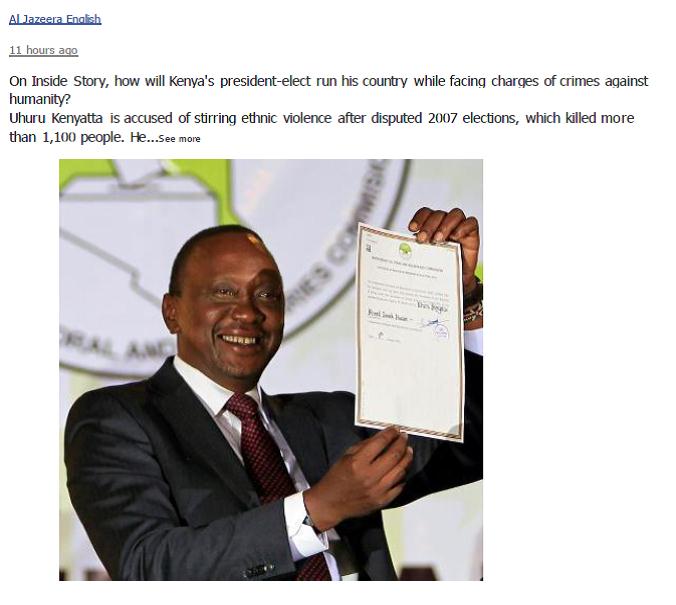
The analysis of social media data for this project was particularly interesting. My data source was the comments following this posting on the Al Jazeera English Facebook feed.

fb

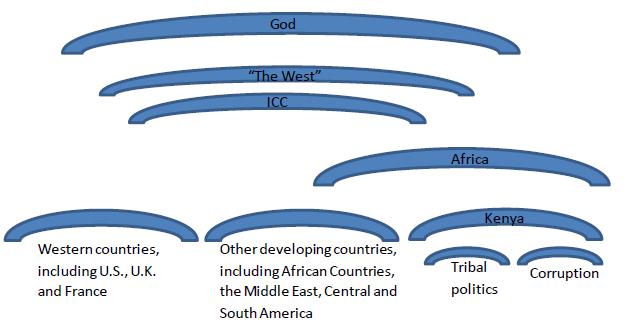
It evolved quite organically. After a number of rounds of coding I noticed that I kept drawing diagrams in the margins of some of the comments. I combined the diagrams into this framework:

scales

Once this framework was built, I looked closely at the ways in which participants used this framework. Sometimes participants made distinct discursive moves between these levels. But when I tried to map the participants’ movements on their individual diagrams, I noticed that my depictions of their movements rarely matched when I returned to a diagram. Although my coding of the framework was very reliable, my coding of the movements was not at all. This led me to notice that oftentimes the frames were being used more indexically. Participants were indexing levels of the frame, and this indexical process created powerful frame shifts. So, on the level of Kenyan politics exclusively, Uhuru’s crimes had one meaning. But juxtaposed against the crimes of other national leaders’ Uhuru’s crimes had a dramatically different meaning. Similarly, when the legitimacy of the ICC was questioned, the charges took on a dramatically different meaning. When Uhuru’s crimes were embedded in the postcolonial East vs West dynamic, they shrunk to the degree that the indictments seemed petty and hypocritical. And, ultimately, when religion was invoked the persecution of one man seemed wholly irrelevant and sacrilegious.

These powerful frame shifts enable the Kenyan public to have a powerful, narrative changing voice in social media. And their social media savvy enables them to gain the attention of media sources that amplify their voices and thus redefine their public narrative.

readyforcnn

Instagram is changing the way I see

I recently joined Instagram (I’m late, I know).

I joined because my daughter wanted to, because her friends had, to see what it was all about. She is artistic, and we like to talk about things like color combinations and camera angles, so Instagram is a good fit for us. But it’s quickly changing the way I understand photography. I’ve always been able to set up a good shot, and I’ve always had an eye for color. But I’ve never seriously followed up on any of it. It didn’t take long on Instagram to learn that an eye for framing and color is not enough to make for anything more than accidental great shots. The great shots that I see are the ones that pick deeper patterns or unexpected contrasts out of seemingly ordinary surroundings. They don’t simply capture beauty, they capture an unexpected natural order or a surprising contrast, or they tell a story. They make you gasp or they make you wonder. They share a vision, a moment, an insight. They’re like the beginning paragraph of a novel or the sketch outline of a poem. Realizing that, I have learned that capturing the obvious beauty around me is not enough. To find the good shots, I’ll need to leave my comfort zone, to feel or notice differently, to wonder what or who belongs in a space and what or who doesn’t, and why any of it would capture anyone’s interest. It’s not enough to see a door. I have to wonder what’s behind it. To my surprise, Instagram has taught me how to think like a writer again, how to find hidden narratives, how to feel contrast again.

Sure this makes for a pretty picture. But what is unexpected about it? Who belongs in this space? Who doesn't? What would catch your eye?

Sure this makes for a pretty picture. But what is unexpected about it? Who belongs in this space? Who doesn’t? What would catch your eye?

This kind of change has a great value, of course, for a social media researcher. The kinds of connections that people forge on social media, the different ways in which people use platforms and the ways in which platforms shape the way we interact with the world around us, both virtual and real, are vitally important elements in the research process. In order to create valid, useful research in social media, the methods and thinking of the researcher have to follow closely with the methods and thinking of the users. If your sensemaking process imitates the sensemaking process of the users, you know that you’re working in the right direction, but if you ignore the behaviors and goals of the users, you have likely missed the point altogether. (For example, if you think of Twitter hashtags simply as an organizational scheme, you’ve missed the strategic, ironic, insightful and often humorous ways in which people use hashtags. Or if you think that hashtags naturally fall into specific patterns, you’re missing their dialogic nature.)

My current research involves the cycle between social media and journalism, and it runs across platforms. I am asking questions like ‘what gets picked up by reporters and why?’ and ‘what is designed for reporters to pick up?’ And some of these questions lead me to examine the differences between funny memes that circulate like wildfire through Twitter leading to trends and a wider stage and the more indepth conversation on public facebook pages, which cannot trend as easily and is far less punchy and digestible. What role does each play in the political process and in constituting news?

Of course, my current research asks more questions than these, but it’s currently under construction. I’d rather not invite you into the workzone until some of the pulp and debris have been swept aside…

Is there Interdisciplinary hope for Social Media Research?

I’ve been trying to wrap my head around social media research for a couple of years now. I don’t think it would be as hard to understand from any one academic or professional perspective, but, from an interdisciplinary standpoint, the variety of perspectives and the disconnects between them are stunning.

In the academic realm:

There is the computer science approach to social media research. From this standpoint, we see the fleshing out of machine learning algorithms in a stunning horserace of code development across a few programming languages. This is the most likely to be opaque, proprietary knowledge.

There is the NLP or linguistic approach, which overlaps to some degree with the cs approach, although it is often more closely tied to grammatical rules. In this case, we see grammatical parsers, dictionary development, and api’s or shared programming modules, such as NLTK or GATE. Linguistics is divided as a discipline, and many of these divisions have filtered into NLP.

Both the NLP and CS approaches can be fleshed out, trained, or used on just about any data set.

There are the discourse approaches. Discourse is an area of linguistics concerned with meaning above the level of the sentence. This type of research can follow more of a strict Conversation Analysis approach or a kind of Netnography approach. This school of thought is more concerned with context as a determiner or shaper of meaning than the two approaches above.

For these approaches, the dataset cannot just come from anywhere. The analyst should understand where the data came from.

One could divide these traditions by programming skills, but there are enough of us who do work on both sides that the distinction is superficial. Although, generally speaker, the deeper one’s programming or qualitative skills, the less likely one is to cross over to the other side.

There is also a growing tradition of data science, which is primarily quantitative. Although I have some statistical background and work with quantitative data sets every day, I don’t have a good understanding of data science as a discipline. I assume that the growing field of data visualization would fall into this camp.

In the professional realm:

There are many companies in horseraces to develop the best systems first. These companies use catchphrases like “big data” and “social media firehose” and often focus on sentiment analysis or topic analysis (usually topics are gleaned through keywords). These companies primarily market to the advertising industry and market researchers, often with inflated claims of accuracy, which are possible because of the opacity of their methods.

There is the realm of market research, which is quickly becoming dependent on fast, widely available knowledge. This knowledge is usually gleaned through companies involved in the horserace, without much awareness of the methodology. There is an increasing need for companies to be aware of their brand’s mentions and interactions online, in real time, and as they collect this information it is easy, convenient and cost effective to collect more information in the process, such as sentiment analyses and topic analyses. This field has created an astronomically high demand for big data analysis.

There is the traditional field of survey research. This field is methodical and error focused. Knowledge is created empirically and evaluated critically. Every aspect of the survey process is highly researched and understood in great depth, so new methods are greeted with a natural skepticism. Although they have traditionally been the anchors of good professional research methods and the leaders in the research field, survey researchers are largely outside of the big data rush. Survey researchers tend to value accuracy over timeliness, so the big, fast world of big data, with its dubious ability to create representative samples, hold little allure or relevance.

The wider picture

In the wider picture, we have discussions of access and use. We see a growing proportion of the population coming online on an ever greater variety of devices. On the surface, the digital divide is fast shrinking (albeit still significant). Some of the digital access debate has been expanded into an understanding of differential use- essentially that different people do different activities while online. I want to take this debate further by focusing on discursive access or the digital representation of language ideologies.

The problem

The problem with such a wide spread of methods, needs, focuses and analytic traditions is that there isn’t enough crossover. It is very difficult to find work that spreads across these domains. The audiences are different, the needs are different, the abilities are different, and the professional visions are dramatically different across traditions. Although many people are speaking, it seems like people are largely speaking within silos or echo chambers, and knowledge simply isn’t trickling across borders.

This problem has rapidly grown because the underlying professional industries have quickly calcified. Sentiment analysis is not the revolutionary answer to the text analysis problem, but it is good enough for now, and it is skyrocketing in use. Academia is moving too slow for the demands of industry and not addressing the needs of industry, so other analytic techniques are not being adopted.

Social media analysis would best be accomplished by a team of people, each with different training. But it is not developing that way. And that, I believe, is a big (and fast growing) problem.

Storytelling about correlation and causation

Many researchers have great war stories to tell about the perilous waters between correlation and causation. Here is my personal favorite:

In the late 90’s, I was working with neurosurgery patients in a medical psychology clinic in a hospital. We gave each of the patients a battery of cognitive tests before their surgery and then administered the same battery 6 months after the surgery. Our goal was to check for cognitive changes that may have resulted from the surgery. One researcher from outside the clinic focused on our strongest finding: a significant reduction of anxiety from pre-op to post-op. She hypothesized that this dramatic finding was evidence that the neural basis for anxiety was affected by the surgery. Had she only taken a minute to explain her  hypothesis in plain terms to a layperson, especially one that could imagine the anxiety a patient could potentially experience hours before brain surgery, she surely would have withdrawn her request for our data and slipped quietly out of our clinic.

“Correlation does not imply causation” is a research catchphrase that is drilled into practitioners from internhood and intro classes onward. It is particularly true when working with language, because all linguistic behavior is highly patterned behavior. Researchers from many other disciplines would kill to have chi square tests as strong as linguists’ chi squares. In fact, linguists have to reach deeper into their statistical toolkits, because the significance levels alone can be misleading or inadequate.

People who use language but don’t study linguistics usually aren’t aware of the degree of patterning that underlies the communication process. Language learning has statistical underpinnings, and language use has statistical underpinnings. It is because of this patterning that linguistic machine learning is possible. But, linguistic patterning is a double edged sword- potentially helpful in programming and harmful in analysis. Correlations abound, and they’re mostly real correlations, although, statistically speaking, some will be products of peculiarities in a dataset. But outside of any context or theory, these findings are meaningless. They don’t speak to the underlying relationship between the variables in any way.

A word of caution to researchers whose work centers around the discovery of correlations. Be careful with your findings. You may have found evidence that shows that a correlation may exist. But that is all you have found. Take your next steps carefully. First, step back and think about your work in layman’s terms. What did you find, and is that really anything meaningful? If your findings still show some prospects, double down further and dig deeper. Try to get some better idea of what is happening. Get some context.

Because a correlation alone is no gold nugget. You may think you’ve found some fashion, but your emperor could very well still be naked.

Time for some Research Zen

As the new semester kicks into gear and work deadlines loom, I find myself ready for a moment of research zen.

2012-12-16 14.18.00

Let’s take a minute to stand in a stream and think about the water. Feel the flow of the water over your feet and by your calves. Feel the pull of constant motion. Feel yourself sink against the current, rooting deeper to keep steady. Breathe the clean outdoor air. Observe the clouds and watch the way the sky reflects in the water in the stream. The stream is not constant. The water passing now is not the water that passed when you started, and the water that passes when you leave will be still different. And yet we call this a stream.

As I observe sources of social media, thinking about sampling, I’m faced with some of the same questions that the stream gives rise to. Although I would define my sources consistently from day to day, their content shifts constantly. The stream is not constant, but rather constantly forming and reforming at my feet.

For a moment, I saw the tide of social media start to turn in favor of taxi drivers. In that moment, I felt both a strong sense of relief from the negativity and a need to revisit my research methods. Today I see that the stream has again turned against the drivers. I could ignore the momentary shift, or I could use this as a moment to again revisit the wisdom of sampling.

If I sample the river at a given point, what should I collect and what does it represent? How, when the water is constantly moving around me, can I represent what I observe within a sample? Could my sampling ever represent a single point in the stream, the stream as a whole, or streams in general? Or will it always be moments in the life of a stream?

In the words of Henry Miller, “The world is not to be put in order. The world is in order. It is for us to put ourselves in unison with this order.” In order to understand this stream, I need to understand what lies beneath it, what gives it its shape and flow, and how it works within its ecosystem.

The ecosystem of public opinion around the taxi system in DC is not one that can be understood purely online. When I see the reflection of clouds on the stream, I need to find the sky. When I see phrases repeated over and over, I need to understand where they come from and how they came to be repeated. In the words of Blaise Pascal “contradiction is not a sign of falsity, nor the lack of contradiction a sign of truth.” No elements in this ecosystem exist independent of context. Each element has its base.

Good research involves a good deal of reflection. It involves digging in against currents and close observation. It involves finding a moment of stillness in the flow of the stream.

Breathe in. Observe carefully. Breathe out. Repeat, continue, focus, research.

Fertile soil from dry dirt. Thank you, Netherlands!

The mood workshop (microanalysis of online data) in Nijmegen last week was immensely helpful for me. In two short days, my research lost some branches and grew some deeper roots. Definitely worth 21+ hours of travel!

Aerial shot of Greenland. Can't tell where the clouds end and the snow and ice begin!

Aerial shot of Greenland. Can’t tell where the clouds end and the snow and ice begin!

The retooling began early on the first day. My first, burning question for the group was about choosing representative data. The shocking first answer: why? To someone with a quantitative background, this question was mind blowing. The sky is up, the ground is down, and data should be representative. But representative of what?

Here we return to the nature of the data. What data are you looking at? What kind of motivated behavior does it represent? Essentially, I am looking at online conversation. We know that counting conversational topics is fruitless- that’s the first truth of conversation analysis. And we know that counting conversational participation is usually misguided. So what was I trying to represent?

My goal is to track a silence that happens across site types, largely independent of stimulus. No matter what kind of news article about taxis in Washington DC, no matter the source, the driver perspective is almost completely absent, and if it is represented the responses are noticeably different or marked. I had thought that if I could find a way to count this underrepresentation I could launch a systematic, grounded critique of the notion of participatory media and pose the question of which values were being maintained from the ground up. What is social capital in online news discourse, who speaks, and which speakers are ratified?

But this is not a question of representative sampling alone. Although sampling could offer a sense of context to the data, the meat and potatoes of the analysis are in fact fodder for conversation analysis. A more useful and interesting research question emerged: how are these online conversations constructed so as to make a pro taxi response dispreferred or marked? This question invokes pronoun usage, intertextuality, conversational reach, crowd based sanctioning, conversational structure and pair parts, register, and more. It provides grounding for a rich, layered analysis. Fertile soil from dry dirt. Thank you, Netherlands.

Canal in Amsterdam (note: the workshop was in Nijmegen, not Amsterdam. Also note: the dangers of parallel parking next to a canal. You'd be safer living in one of these houseboats!

Canal in Amsterdam (note: the workshop was in Nijmegen, not Amsterdam. Also note: the dangers of parallel parking next to a canal. You’d be safer living in one of these houseboats!

Turns out Ethnography happens one slice at a time

Some of you may have noticed that I promised to report some research and then didn’t.

Last semester, for my Ethnography of Communication class, I did an Ethnography of DC taxi drivers. The theme of the Ethnography was “the voice of the drivers.” It was multilayered, and it involved data from a great variety of sources. I had hoped to share my final paper for the class here, but that won’t work for three reasons.

1.) The nature of Ethnography. Ethnography involves collecting a great deal of data and then choosing what to report, in what way, and in what context. The goal of the final paper was to reflect on the methodology. This was an important exercise, but I really wanted to share more of my findings and less of my methodology here.

2.) The particular aspect of my findings that I most want to share here has to do with online discourse. Specifically, I want to examine the lack of representation of the drivers perspective online. There are quite a few different ways to accomplish this. I have tried to do it a number of ways, using different slices of data and using different analytic strategies. But I haven’t decided which is the best set of data or method of analysis. But I am a very lucky researcher. Next week I’m headed to a workshop at Radbound University in Nijmegen, Netherlands. The workshop is on the Microanalysis of Online Discourse. I am eager to bring my data and methodological questions and to recieve insight from such an amazing array of researchers. I am also very eager to see what they bring!

Much of the discussion in the analysis of online discourse either excludes the issue of representation altogether or focuses on it entirely. Social media is often hailed as the great democratizer of communication. Internet access was long seen as the biggest obstacle to this new democracy . From this starting point, much of the research has evolved to consider more of nuances of differential use, including the complicated nature of internet access as well as behavior and goals of internet users. This part of my findings is an example of differential use and of different styles of participation. Working with this data has changed the way I see social media and the way I understand the democratization of news.

3.) Scope. The other major reason why I haven’t shared my findings is because of the sheer scope of this project. I was fortunate enough to only have taken one class last semester, which left me the freedom to work much harder on it. Also, as a working/student mom, I chose a project that involved my whole family in an auto-ethnographic way, so much of my work brought me closer to my family, rather than farther apart (spending time away from family to study is one of the hardest parts of working student motherhood!)

I have amassed quite a bit of data at this point, and I plan to write a few different papers using it.

Stay tuned, because I will release slices of it. But have some patience, because each slice will only be released in its own good time.


At this point, I feel the need to reference the Hutzler Banana Slicer

Turns out, Ethnography is more like this:


than like this:

Data Storytelling

In the beginning of our Ethnography of Communication class, one of the students asked about the kinds of papers one writes about an ethnography. It seemed like a simple question at the time. In order to report on ethnographic data, the researcher chooses a theme and then pulls out the parts of their data that fit the theme. Now that I’m at the point in my ethnography where I’m choosing what to report, I can safely say that this question is not one with an easy answer.

At this point, I’ve gathered together a tremendous amount of data about DC taxi drivers. I’ve already given my final presentation for my class, and written most of my final paper. But the data gathering phase hasn’t ended yet. I have been wondering whether I have enough data gathered together to write a book, and I probably could write a book, but that still doesn’t make my project feel complete. I don’t feel like the window I’ve carved is large enough to do this topic any justice.

The story that I set out to tell about the drivers is one of their absence in the online public sphere. As the wife of a DC driver, I was sick and tired of seeing blog posts and newspaper articles with seemingly unending streams of offensive, ignorant, or simply one sided comments. This story turns out to be one with many layers, one that goes far beyond issues of internet access, delves deeply into matters of differential use of technology, and one that strikes fractures into the soil of the grand potential of participatory democracy. It is also a story grounded in countless daily interactions, involving a large number of participants and situations. The question is large, the data abundant, and the paths to the story many. Each more narrow path begs a depth that is hungry for more data and more analysis. Each answer is defined by more questions. More specifically, do I start with the rides? With a specific ride? With the drivers? With a specific driver? With a specific piece of legislation? With one online discussion or theme? How can I make sure that my analysis is grounded and objective? How far do I trace the story, and which parts of the story does it leave out? What happens with the rest of the story? What is my responsibility and to whom?

This paper will clearly not be the capstone to the ethnography, just one story told through the data I’ve gathered together in the past few months. More stories can be told, and will be told with the data. Specifically, I’m hoping to delve more deeply into the driver’s social networks, for their role in information exchange. And the fallout from stylistic differences in online discussions. And, more prescriptively, into ways that drivers voices can be better represented in the public sphere. And maybe more?

It feels strange to write a paper that isn’t descriptive of the data as a whole. Every other project that I’ve worked on has led to a single publication that summarized the whole set. It seems strange, coming from a quantitative perspective where the data strongly confines the limits of what can and cannot be said in the report and what is more or less important to include in the report, to have a choice of data, and, more importantly, a choice of story to tell. Instead of pages of numbers to look through, compare and describe, I’m entering the final week of this project with the same cloud of ambiguity that has lingered throughout. And I’m looking for ways that my data can determine what can and cannot be reported on and what stories should be told. Where, in this sea of data, is my life raft of objectivity? (Hear that note of drama? That comes from the lack of sleep and heightened anxiety that finals bring about- one part of formal education that I will not miss!!)

I have promised to share my paper here once it has been written. I might end up making some changes before sharing it, but I will definitely share it. My biggest hope is that it will inspire some fresh, better informed conversation on the taxi situation in DC and on what it means to be represented in a participatory democracy.

What do all of these polling strategies add up to?

Yesterday was a big first for research methodologists across many disciplines. For some of the newer methods, it was the first election that they could be applied to in real time. For some of the older methods, this election was the first to bring competing methodologies, and not just methodological critiques.

Real time sentiment analysis from sites like this summarized Twitter’s take on the election. This paper sought to predict electoral turnout using google searches. InsideFacebook attempted to use Facebook data to track voting. And those are just a few of a rapid proliferation of data sources, analytic strategies and visualizations.

One could ask, who are the winners? Some (including me) were quick to declare a victory for the well honed craft of traditional pollsters, who showed that they were able to repeat their studies with little noise, and that their results were predictive of a wider real world phenomena. Some could call a victory for the emerging field of Data Science. Obama’s Chief Data Scientist is already beginning to be recognized. Comparisons of analytic strategies will spring up all over the place in the coming weeks. The election provided a rare opportunity where so many strategies and so many people were working in one topical area. The comparisons will tell us a lot about where we are in the data horse race.

In fact, most of these methods were successful predictors in spite of their complicated underpinnings. The google searches took into account searches for variations of “vote,” which worked as a kind of reliable predictor but belied the complicated web of naturalistic search terms (which I alluded to in an earlier post about the natural development of hashtags, as explained by Rami Khater of Al Jezeera’s The Stream, a social network generated newscast). I was a real-world example of this methodological complication. Before I went to vote, I googled “sample ballot.” Similar intent, but I wouldn’t have been caught in the analyst’s net.

If you look deeper at the Sentiment Analysis tools that allow you to view the specific tweets that comprise their categorizations, you will quickly see that, although the overall trends were in fact predictive of the election results, the data coding was messy, because language is messy.

And the victorious predictive ability of traditional polling methods belies the complicated nature of interviewing as a data collection technique. Survey methodologists work hard to standardize research interviews in order to maximize the reliability of the interviews. Sometimes these interviews are standardized to the point of recording. Sometimes the interviews are so scripted that interviewers are not allowed to clarify questions, only to repeat them. Critiques of this kind of standardization are common in survey methodology, most notably from Nora Cate Schaeffer, who has raised many important considerations within the survey methodology community while still strongly supporting the importance of interviewing as a methodological tool. My reading assignment for my ethnography class this week is a chapter by Charles Briggs from 1986 (Briggs – Learning how to ask) that proves that many of the new methodological critiques are in fact old methodological critiques. But the critiques are rarely heeded, because they are difficult to apply.

I am currently working on a project that demonstrates some of the problems with standardizing interviews. I am revising a script we used to call a representative sample of U.S. high schools. The script was last used four years ago in a highly successful effort that led to an admirable 98% response rate. But to my surprise, when I went to pull up the old script I found instead a system of scripts. What was an online and phone survey had spawned fax and e-mail versions. What was intended to be a survey of principals now had a set of potential respondents from the schools, each with their own strengths and weaknesses. Answers to common questions from school staff were loosely scripted on an addendum to the original script. A set of tips for phonecallers included points such as “make sure to catch the name of the person who transfers you, so that you can specifically say that Ms X from the office suggested I talk to you” and “If you get transferred to the teacher, make sure you are not talking to the whole class over the loudspeaker.”

Heidi Hamilton, chair of the Georgetown Linguistics department, often refers to conversation as “climbing a tree that climbs back.” In fact, we often talk about meaning as mutually constituted between all of the participants in a conversation. The conversation itself cannot be taken outside of the context in which it lives. The many documents I found from the phonecallers show just how relevant these observations can be in an applied research environment.

The big question that arises from all of this is one of a practical strategy. In particular, I had to figure out how to best address the interview campaign that we had actually run when preparing to rerun the campaign we had intended to run. My solution was to integrate the feedback from the phonecallers and loosen up the script. But I suspect that this tactic will work differently with different phonecallers. I’ve certainly worked with a variety of phonecallers, from those that preferred a script to those that preferred to talk off the cuff. Which makes the best phonecaller? Neither. Both. The ideal phonecaller works with the situation that is presented to them nimbly and professionally while collecting complete and relevant data from the most reliable source. As much of the time as possible.

At this point, I’ve come pretty far afield of my original point, which is that all of these competing predictive strategies have complicated underpinnings.

And what of that?

I believe that the best research is conscious of its strengths and weaknesses and not afraid to work with other strategies in order to generate the most comprehensive picture. As we see comparisons and horse races develop between analytic strategies, I think the best analyses we’ll see will be the ones that fit the results of each of the strategies together, simultaneously developing a fuller breakdown of the election and a fuller picture of our new research environment.

Education from the Bottom Up?

Last night I attended a talk by Shirley Bryce Heath about her new book, Words at Work and Play, moderated by Anne Harper Charity Hudley and Frederick Erickson. Dr Bryce Heath has been following a group of 300 families for 30 years, and in her talk she addressed many of the changes she’d seen in the kids in the time she’d been observing them. She made one particularly interesting point. She mentioned that the world of assessment, and, in fact much of the adult world hasn’t kept up with the kids’ evolution. The assessments that we subject kids to are traditional, reflecting traditional values and sources. She went as far as to say that we don’t know how to see, appreciate or notice these changes, and she pointed out that much of new styles of learning came outside of the school environment.

This part of her talk reminded me of an excellent blog post I read yesterday about unschooling. Unschooling is the process of learning outside of a structured environment. It goes further than homeschooling, which can involve structured curricula. It is curricularly agnostic and focused on the learning styles, interests, and natural motivation of the students. I mentioned the blog post to Terrence Wiley, president of the Center for Applied Linguistics, and he emphasized the underlying idealism of unschooling. It rests on the basic belief that everyone is naturally academically motivated and interested and will naturally embrace learning, in their own way, given the freedom to do it. Unschooling is, as some would say my “spirit animal.” I don’t have the time or the resources to do it with my own kids, and I’m not sure I would even if I were fully able to do it. I have no idea how it could be instituted in any kind of egalitarian or larger scale way. But I still love the idea, in all it’s unpracticality. (Dr Wiley gave me a few reading assignments, explaining that ‘everything old in education is new again’)

Then today I read a blog about the potential of using Wikipedia as a textbook. This idea is very striking, not just because Wikipedia was mostly accurate, freely available, covered the vast majority of the material in this professor’s traditional textbooks, and has an app that will help anyone interested create a custom textbook, but because it actually addresses what kids do anyway! Just this past weekend, my daughter was writing a book report, and I kept complaining that she chose to use Wikipedia to look up the spelling of a character’s name rather than walk upstairs and grab the book. Kids use Wikipedia often and for all kinds of things, and it is often more common for parents and educators to forbid or dismiss this practice than to jump right in with them. I suggest that the blogger not only use Wikipedia, but use the text as a way to show what is or is not accurate, how to tell, and where to find other credible, collaborative sources when it doubt. What an amazing opportunity!

So here’s the question that all of this has been leading to: Given that the world around is is rapidly changing and that our kids are more adept at staying abreast of these changes than they are, could it be time to turn the old expert-novice/ teacher-student paradigm on its head, at least in part? Maybe we need to find ways to let some knowledge come from the bottom up. Maybe we need to let them be the experts. Maybe we need to, at least in part, rethink our role in the educating process?

Frederick Erickson made an excellent point about teaching “You have to learn your students in order to teach them.” He talked about spending the first few days in a class gathering the expertise of the students, and using that knowledge when creating assignments or assigning groups. (I believe Dr Hudley mentioned that she did this, too. Or maybe he supplied the quote, and she supplied the example?)

All of this makes me wonder what the potential is for respecting the knowledge and expertise of the students, and working from there. What does bottom-up or student-led education look like? How can it be integrated into the learning process in order to make it more responsive, adaptive and modern?

Of course, this is as much a dream for a wider society as unschooling is for my own family. To a large extent, practicality shoots it all in the foot with the starting gun. But a girl can dream, no?