Reflections on Social Network Analysis & Social Media Research from #SMSociety13

A dispatch from a quantitative side of social media research!

Here are a few of my reflections from the Social Media & Society conference in Halifax and my Social Network Analysis class.

I should first mention that I was lucky in two ways.

  1. I finished the James Bond movie ‘Skyfall’ as my last Air Canada flight was landing. (Ok, I didn’t have to mention that)
  2. I finished my online course on Social Network Analysis  hours before leaving for a conference that kicked off with an excellent  talk about Networks and diffusion. And then on the second day of the conference I was able to manipulate a network visualization with my hands using a 96 inch touchscreen at the Dalhousie University Social Media Lab  (Great lab, by the way, with some very interesting and freely available tools)


This picture doesn't do this screen justice. This is *data heaven*

This picture doesn’t do this screen justice. This is *data heaven*

Social networks are networks built to describe human action in social media environments. They contain nodes (dots), which could represent people, usernames, objects, etc. and edges, lines joining nodes that represent some kind of relationship (friend, follower, contact, or a host of other quantitative measures). The course was a particularly great introduction to Social Network Analysis, because it included a book that was clear and interesting, a set of youtube videos and a website, all of which were built to work together. The instructor (Dr Jen Golbeck, also the author of the book and materials) has a very unique interest in SNA which gives the class an important added dimension. Her focus is on operational definitions and quantitative measures of trust, and because of this we were taught to carefully consider the role of the edges and edge weights in our networks.

Sharad Goel’s plenary at #SMSociety13 was a very different look at networks. He questioned the common notion of viral diffusion online by looking at millions of cases of diffusion. He discovered that very few diffusions actual resemble any kind of viral model. Instead, most diffusion happens on a very small scale. He used Justin Bieber as an example of diffusion. Bieber has the largest number of followers on Twitter, so when it he posts something it has a very wide reach (“the Bieber effect”). However, people don’t share content as often as we imagine. In fact, only a very small proportion of his followers share it, and only a small proportion of their followers share it. Overall, the path is wide and shallow, with less vertical layers than we had previously envisioned.

Goel’s research is an example of Big Data in action. He said that Big Data methods are important when the phenomenon you want to study happens very infrequently (e.g. one in a million), as is the case for actual instances of viral diffusion.

His conclusions were big, and this line of research is very informative and useful for anyone trying to communicate on a large scale.

Sidenote: the term ‘ego network’ came up quite a few times during the conference, but not everyone knew what an ego network is. An ego network begins with a single node and is measured by degrees. A one degree social network looks a bit like an asterisk- it simply shows all of the nodes that are directly connected to the original node. A 1.5 degree network would include the first degree connections as well as the connections between them. A two degree network contains all of the first degree connections to these nodes that were in the one degree network. And so on.

One common research strategy is to compare across ego networks.

My next post will move on from SNA to more qualitative aspects of the conference
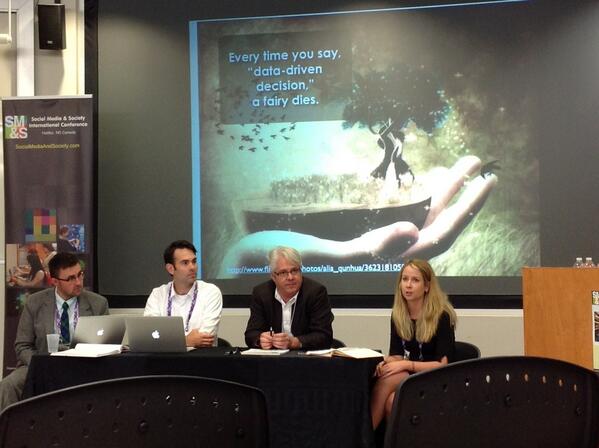
Source: https://twitter.com/JeffreyKeefer/status/378921564281921537/photo/1 This was the backdrop for a qualitive panel

Source: https://twitter.com/JeffreyKeefer/status/378921564281921537/photo/1
This was the backdrop for a qualitative panel. It says “Every time you say ‘data driven decision’ a fairy dies.

More Takeaways from the DC-AAPOR/WSS Summer Conference

Last week I shared my notes from the first two sessions of the DC-AAPOR/ WSS Summer conference preview/review. Here are the rest of the notes, covering the rest of the conference:

Session 3: Accessing and Using Records

  • Side note: Some of us may benefit from a support group format re: matching administrative records
  • AIR experiment with incentives & consent to record linkage: $2 incentive s/t worse than $0. $20 incentive yielded highest response rate and consent rate earlies t in the process, cheaper than phone follow-up
    • If relevant data is available, $20 incentive can be tailored to likely nonrespondents
    • Evaluating race & Hispanic origin questions- this was a big theme over the course of this conference. The social constructiveness of racial/ethnic identity doesn’t map well to survey questions. This Census study found changes in survey answers based on context, location, social position, education, ambiguousness of phenotype, self-perception, question format, census tract, and proxy reports. Also a high number of missing answers.

Session 4: Adaptive Design in Government Surveys

  • A potpourri of quotes from this session that caught my eye:
    • Re: Frauke Kreuter “the mother of all paradata”
      Peter Miller: “Response rates is not the goal”
      Robert Groves: “The way we do things is unsustainable”
    • Response rates are declining, costs are rising
    • Create a dashboard that works for your study. Include the relevant cars you need in order to have a decision maing tool that is tailored/dynamic and data based
      • Include paradata, response data
      • Include info re: mode switching, interventions
      • IMPORTANT: prioritize cases, prioritize modes, shift priorities with experience
      • Subsample open cases (not yet respondes)
      • STOP data collection at a sensible point, before your response bias starts to grow exponentially and before you waste money on expensive interventions that can actually work to make your data less representative
    • Interviewer paradata
      • Chose facts over inference
      • Presence or absence of key features (e.g. ease of access, condition of property)
        • (for a phone survey, these would probably include presence or absence of answer or answering mechanism, etc.)
        • For a household survey, household factors more helpful than neighborhood factors
    • Three kinds of adaptive design
      • Fixed design (ok, this is NOT adaptive)- treat all respondents the same
      • Preplanned adaptive- tailor mailing efforts in advance based on response propensity models
      • Real-time adaptive- adjust mailing efforts in response to real-time response data and evolving response propensities
    • Important aspect of adaptive design: document decisions and evaluate success, re-evaluate future strategy
    • What groups are under-responding and over-responding?
      • Develop propensity models
      • Design modes accordingly
      • Save $ by focusing resources
    • NSCG used adaptive design

Session 5: Public Opinion, Policy & Communication

  • Marital status checklist: categories not mutually exclusive- checkboxes
    • Cain conducted a meta-analysis of federal survey practices
    • Same sex marriage
      • Because of DOMA, federal agencies were not able to use same sex data. Now that it’s been struck down, the question is more important, has funding and policy issues resting on it
      • Exploring measurement:
        • Review of research
        • Focus groups
        • Cognitive interviews
        • Quantitative testing ß current phase
  • Estimates of same sex marriage dramatically inflated by straight people who select gender incorrectly (size/scope/scale)
  • ACS has revised marriage question
  • Instead of mother, father, parent 1, parent 2, …
    • Yields more same sex couples
    • Less nonresponse overall
    • Allow step, adopted, bio, foster, …
    • Plain language
      • Plain Language Act of 2010
      • See handout on plain language for more info
      • Pretty much just good writing practice in general
      • Data visualization makeovers using Tufte guidance
        • Maybe not ideal makeovers, but the data makeover idea is a fun one. I’d like to see a data makeover event of some kind…

Session 7: Questionaire Design and Evaluation

  • Getting your money’s worth! Targeting Resources to Make Cognitice Interviews Most Effective
    • When choosing a sample for cognitive interviews, focus on the people who tend to have the problems you’re investigating. Otherwise, the likelihood of choosing someone with the right problems is quite low
    • AIR experiment: cognitive interviews by phone
      • Need to use more skilled interviewers by phone, because more probing is necessary
      • Awkward silences more awkward without clues to what respondent is doing
      • Hard to evaluate graphics and layout by phone
      • When sharing a screen, interviewer should control mouse (they learned this the hard way)
      • ON the Plus side: more convenient for interviewee and interviewer, interviewers have access to more interviewees, data quality similar, or good enough
      • Try Skype or something?
      • Translation issues (much of the cognitive testing centered around translation issues- I’m not going into detail with them here, because these don’t transfer well from one survey to the next)
        • Education/internationall/translation: They tried to assign equivalent education groups and reflect their equivalences in the question, but when respondents didn’t agree to the equivalences suggested to them they didn’t follow the questions as written

Poster session

  • One poster was laid out like candy land. Very cool, but people stopped by more to make jokes than substantive comments
  • One poster had signals from interviews that the respondent would not cooperate, or 101 signs that your interview will not go smoothly. I could see posting that in an interviewer break room…

Session 8: Identifying and Repairing Measurement and Coverage Errors

  • Health care reform survey: people believe what they believe in spite of the terms and definitions you supply
  • Paraphrased Groves (1989:449) “Although survey language can be standardized, there is no guarantee that interpretation will be the same”
  • Politeness can be a big barrier in interviewer/respondent communication
  • Reduce interviewer rewording
  • Be sure to bring interviewers on board with project goals (this was heavily emphasized on AAPORnet while we were at this conference- the importance of interviewer training, valuing the work of the interviewers, making sure the interviewers feel valued, collecting interviewer feedback and restrategizing during the fielding period and debriefing the interviewers after the fielding period is done)
  • Response format effects when measuring employment: slides requested

Takeaways from the DC AAPOR & WSS Summer Conference Preview/Review 2013

“The way we do things is unsustainable” – Robert Groves, Census

This week I attended a great conference sponsored by DC-AAPOR. I’m typing up my notes from the sessions to share, but there are a lot of notes. This covers the morning sessions on day 1.

We are coming to a new point of understanding with some of the more recent developments in survey research. For the first time in recent memory, the specter of limited budgets loomed large. Researchers weren’t just asking “How can I do my work better?” but “How can I target my improvements so that my work can be better, faster, and less expensive?”

Session 1: Understanding and Dealing with Nonresponse

  • Researchers have been exploring the potential of nonresponse propensity modeling for a while. In the past, nonresponse propensities were used as a way to cut down on bias and draw samples that should yield to a more representative response group.
  • In this session, nonresponse propensity modeling was seen as a way of helping to determine a cutoff point in survey data collection.
  • Any data on mode propensity for individual respondents (in longitudinal surveys) or groups of respondents can be used to target people in their likely best mode from the beginning, instead of treating all respondents to the same mailing strategy. This can drastically reduce field time and costs.
  • Prepaid incentives have become accepted best practice in the world of incentives
  • Our usual methods of contact are continually less successful. It’s good to think outside the box. (Or inside the box: one group used certified UPS mail to deliver prepaid incentives)
  • Dramatic increases in incentives dramatically increased response rates and lowered field times significantly
  • Larger lag times in longitudinal surveys led to a larger dropoff in response rate
  • Remember Leverage Salience Theory- people with a vested interest in a survey are more likely to respond (something to keep in mind when writing invitations, reminders, and other respondent materials, etc.)
  • Nonresponse propensity is important to keep in mind in the imputation phase as well as the mailing or fielding phase of a survey
  • Re-engaging respondents in longitudinal surveys is possible. Recontacting can be difficult, esp. finding updated contact information. It would be helpful to share strategies re: maiden names, Spanish names, etc.


Session 2: Established Modes & New Technologies

  • ACASI>CAPI in terms of sensitive info
  • Desktop & mobile respondents follow similar profiles, vary significantly from distribution of traditional respondent profiles
  • Mobile respondents log frequent re-entries onto the surveys, so surveys must allow for saved progress and reentry
  • Mobile surveys that weren’t mobile optimized had the same completion rates as mobile surveys that were optimized. (There was some speculation that this will change over time, as web optimization becomes more standard)
  • iPhones do some mobile optimization of their own (didn’t yield higher complete rates, though, just a prettier screenshot)
  • The authors of the Gallup paper (McGeeney & Marlar) developed a best practices matrix- I requested a copy
  • Smartphone users are more likely to take a break while completing a survey (according to paradata based on OS)
  • This session boasted a particularly fun presentation by Paul Schroeder (abt SRBI) about distracted driving (a mobile survey! Hah!) in which he “saw the null hypothesis across a golden field, and they ran toward each other and embraced.” He used substantive responses, demographics, etc. to calculate the ideal number of call attempts for different survey subgroups. (This takes me back to a nonrespondent from a recent survey we fielded with a particularly large number of contact attempts, who replied to an e-mail invitation to ask if we had any self-respect left at that point)

Language use & gaps in STEM education

Today our microanalytic research group focused on videos of STEM education.


Watching STEM classes reminds me of a field trip a fellow researcher and I took to observe a physics class that used project based learning. Project based learning is a more hands on and collaborative teaching approach which is gaining popularity among physics educators as an alternative to traditional lecture. We observed an optics lab at a local university, and after the class we spoke about what we had observed. Whereas the other researcher had focused on the optics and math, I had been captivated by the awkwardness of the class. I had never envisioned the PJBL process to be such an awkward one!


The first video that we watched today involved a student interchangeably using the terms chart and graph and softening their use with the term “thing.” There was some debate among the researchers as to whether the student had known the answer but chosen to distance himself from the response or whether the student was hedging because he was uncertain. The teacher responded by telling the student not to talk about things, but rather to talk to her in math terms.


What does it mean to understand something in math? The math educators in the room made it clear that a lack of the correct terminology signaled that the student didn’t necessarily understand the subject matter. There was no way for the teacher to know whether the student knew the difference between a chart and a graph from their use of the terms. The conversation on our end was not about the conceptual competence that the student showed. He was at the board, working through the problem, and he had begun his interaction with a winding description of the process necessary (as he imagined it) to solve the problem. It was clear that he did understand the problem and the necessary steps to solve it on some level (whether correct or not), but that level of understanding was not one that mattered.


I was surprised at the degree to which the use of mathematical language was framed as a choice on the part of the student. The teacher asked the student to use mathematical language with her. One math educator in our group spoke about students “getting away with fudging answers.” One researcher said that the correct terms “must be used,” and another commented about the lack of correct terms as indication that the student did “not have a proper understanding” of the material. All of this talk seems to bely the underlying truth that the student chose to use inexact language for a reason (whether social or epistemic).


The next video we watched showed a math teacher working through a problem. I was really struck by her lack of enthusiasm. I noticed her sighs, her lack of engagement with the students even when directly addressing them, and her tone when reading the problem from the textbook. Despite her apparent lack of enthusiasm, her mood appeared considerably brighter when she finished working through the problem. I found this interesting, because physics teachers usually report that their favorite part of their job is watching the students’ “a-ha!” moments. Maybe the rewards of technical problem solving are a motivator for both students and teachers alike? But the process of technical problem solving itself is rarely as motivating.


All of this leads me to one particularly interesting question. How do people in STEM learning settings distance themselves from the material? What discursive tools do they use? Who uses these discursive tools? And does the use of these tools change over time? I wonder in particular whether discursive distancing, which often parallels female discursive patterns, is more common among females than males as they progress through their education? Is there any kind of quantitative correlate to the use of discursive distancing? Is it more common among people who believe that they aren’t good at STEM? Is discursive distancing less common among people who pursue STEM careers? Is there a correlation between distancing and test scores?


Awkwardness in STEM education is fertile ground for qualitative researchers. To what extent is the learning or solving process emphasized and to what extent is the answer valued above all else? How is mathematical language socialized? The process of solving technical problems is a messy and uncomfortable one. It rarely goes smoothly, and in fact challenges often lead to more challenges. The process of trying and failing or trying and learning is not a sexy or attractive one, and there is rampant concern that focusing on the process of learning robs students of the ability to demonstrate their knowledge in a way that matters to people who speak the traditional languages of math and science.


We spoke a little about the phenomena of connected math. It sounds to me very closely parallel to project based learning initiatives in physics. I was left wondering why such a similar teaching process could be valued as a teaching tool for all students in one field and relegated to a teaching tool for struggling students in another neighboring field. I wonder about the similarities and differences between the outcomes of these methods. Much of this may rest on politics, and I suspect that the politics are rooted in deeply held and less questioned beliefs about STEM education.


STEM education initiatives have grown quite a bit in recent years, and it’s clear that there is quite a bit of interesting research left to be done.

Upcoming DC Event: Online Research Offline Lunch

ETA: Registration for this event is now CLOSED. If you have already signed up, you will receive a confirmation e-mail shortly. Any sign-ups after this date will be stored as a contact list for any future events. Thank you for your interest! We’re excited to gather with such a diverse and interesting group.

—–

Are you in or near the DC area? Come join us!

Although DC is a great meeting place for specific areas of online research, there are few opportunities for interdisciplinary gatherings of professionals and academics. This lunch will provide an informal opportunity for a diverse set of online researchers to listen and talk respectfully about our interests and our work and to see our endeavors from new, valuable perspectives.

Date & Time: August 6, 2013, 12:30 p.m.

Location: Near Gallery Place or Metro Center. Once we have a rough headcount, we’ll choose an appropriate location. (Feel free to suggest a place!)

Please RSVP using this form:

Go back

Your message has been sent

Warning
Warning
Warning
Warning

Warning.

What is the role of Ethnography and Microanalysis in Online Research?

There is a large disconnect in online research.

The largest, most profile, highest value and most widely practiced side of online research was created out of a high demand to analyze the large amount of consumer data that is constantly being created and largely public available. This tremendous demand led to research methods that were created in relative haste. Math and programming skills thrived in a realm where social science barely made a whisper. The notion of atheoretical research grew. The level of programming and mathematical competence required to do this work continues to grow higher every day, as the fields of data science and machine learning become continually more nuanced.

The largest, low profile, lowest value and increasingly more practiced side of online research is the academic research. Turning academia toward online research has been like turning a massive ocean liner. For a while online research was not well respected. At this point it is increasingly well respected, thriving in a variety of fields and in a much needed interdisciplinary way, and driven by a search for a better understanding of online behavior and better theories to drive analyses.

I see great value in the intersection between these areas. I imagine that the best programmers have a big appetite for any theory they can use to drive their work in a useful and productive ways. But I don’t see this value coming to bear on the market. Hiring is almost universally focused on programmers and data scientists, and the microanalytic work that is done seems largely invisible to the larger entities out there.

It is common to consider quantitative and qualitative research methods as two separate languages with few bilinguals. At the AAPOR conference in Boston last week, Paul Lavarakas mentioned a book he is working on with Margaret Roller which expands the Total Survey Error model to both quantitative and qualitative research methodology. I spoke with Margaret Roller about the book, and she emphasized the importance of qualitative researchers being able to talk more fluently and openly about methodology and quality controls. I believe that this is, albeit a huge challenge in wording and framing, a very important step for qualitative research, in part because quality frameworks lend credibility to qualitative research in the eyes of a wider research community. I wish this book a great deal of success, and I hope that it is able to find an audience and a frame outside the realm of survey research (Although survey research has a great deal of foundational research, it is not well known outside of the field, and this book will merit a wider audience).

But outside of this book, I’m not quite sure where or how the work of bringing these two distinct areas of research can or will be done.

Also at the AAPOR conference last week, I participated in a panel on The Role of Blogs in Public Opinion Research (intro here and summary here). Blogs serve a special purpose in the field of research. Academic research is foundational and important, but the publish rate on papers is low, and the burden of proof is high. Articles that are published are crafted as an argument. But what of the bumps along the road? The meditations on methodology that arise? Blogs provide a way for researchers to work through challenges and to publish their failures. They provide an experimental space where fields and ideas can come together that previously hadn’t mixed. They provide a space for finding, testing, and crossing boundaries.

Beyond this, they are a vehicle for dissemination. They are accessible and informally advertised. The time frame to publish is short, the burden lower (although I’d like to believe that you have to earn your audience with your words). They are a public face to research.

I hope that we will continue to test these boundaries, to cross over barriers like quantitative and qualitative that are unhelpful and obtrusive. I hope that we will be able to see that we all need each other as researchers, and the quality research that we all want to work for will only be achieved through the mutual recognition that we need.

Revisiting Latino/a identity using Census data

On April 10, I attended a talk by Jennifer Leeman (Research Sociolinguist @Census and Assistant Professor @George Mason) entitled “Spanish and Latino/a identity in the US Census.” This was a great talk. I’ll include the abstract below, but here are some of her main points:

  • Census categories promote and legitimize certain understandings, particularly because the Census, as a tool of the government, has an appearance of neutrality
  • Census must use categories from OMB
  • The distinction between race and ethnicity is fuzzy and full of history.
    • o   In the past, this category has been measured by surname, mothertongue, birthplace
      o   Treated as hereditary (“perpetual foreigner” status)
      o   Self-id new, before interviewer would judge, record
  • In the interview context, macro & micro meet
    • o   Macro level demographic categories
    • o   Micro:
      • Interactional participant roles
      • Indexed through labels & structure
      • Ascribed vs claimed identities
  • The study: 117 telephone interviews in Spanish
    • o   2 questions, ethnicity & race
    • o   Ethnicity includes Hispano, Latino, Español
      • Intended as synonyms but treated as a choice by respondents
      • Different categories than English (Adaptive design at work!)
  • The interviewers played a big role in the elicitation
    • o   Some interviewers emphasized standardization
      • This method functions differently in different conversational contexts
    • o   Some interviewers provided “teaching moments” or on-the-fly definitions
      • Official discourses mediated through interviewer ideologies
      • Definitions vary
  • Race question also problematic
    • o   Different conceptions of Indioamericana
      • Central, South or North American?
  • Role of language
    • o   Assumption of monolinguality problematic, bilingual and multilingual quite common, partial and mixed language resources
    • o   “White” spoken in English different from “white” spoken in Spanish
    • o   Length of time in country, generation in country belies fluid borders
  • Coding process
    • o   Coding responses such as “American, born here”
    • o   ~40% Latino say “other”
    • o   Other category ~ 90% Hispanic (after recoding)
  • So:
    • o   Likely result: one “check all that apply” question
      • People don’t read help texts
    • o   Inherent belief that there is an ideal question out there with “all the right categories”
      • Leeman is not yet ready to believe this
    • o   The takeaway for survey researchers:
      • Carefully consider what you’re asking, how you’re asking it and what information you’re trying to collect
  • See also Pew Hispanic Center report on Latino/a identity


 ABSTRACT

Censuses play a crucial role in the institutionalization and circulation of specific constructions of national identity, national belonging, and social difference, and they are a key site for the production and institutionalization of racial discourse (Anderson 1991; Kertzer & Arel 2002; Nobles 2000; Urla 1994).  With the recent growth in the Latina/o population, there has been increased interest in the official construction of the “Hispanic/Latino/Spanish origin” category (e.g., Rodriguez 2000; Rumbaut 2006; Haney López 2005).  However, the role of language in ethnoracial classification has been largely overlooked (Leeman 2004). So too, little attention has been paid to the processes by which the official classifications become public understandings of ethnoracial difference, or to the ways in which immigrants are interpellated into new racial subjectivities.

This presentation addresses these gaps by examining the ideological role of Spanish in the history of US Census Bureau’s classifications of Latina/os as well as in the official construction of the current “Hispanic/Latino/Spanish origin” category. Further, in order to gain a better understanding of the role of the census-taking in the production of new subjectivities, I analyze Spanish-language telephone interviews conducted as part of Census 2010.  Insights from recent sociocultural research on the language and identity (Bucholtz and Hall 2005) inform my analysis of how racial identities are instantiated and negotiated, and how respondents alternatively resist and take up the identities ascribed to them.

* Dr. Leeman is a Department of Spanish & Portuguese Graduate (GSAS 2000).

Dispatch from the quantitative | qualitative border

On Tuesday evening I attended my first WAPA meeting (Washington Association of Professional Anthropologists). This group meets monthly, first with a happy hour and then with a speaker. Because I have more of a quantitative background, the work of professional anthropologists really blows my mind. The topics are wide ranging and the work interesting and innovative. I’ve been sorry to miss so many of their gatherings.

This week’s topic was near and dear to my heart in two ways.

1. The work was done in a survey context as a qualitative investigation preceding the development of survey questions. As a professional survey methodologist, I have worked through the surprisingly complicated question writing process many hundreds of times, so this approach really fascinates me!

2. The work surrounded the topic of childbirth. As a mother of two and a [partially] trained birth assistant, I love to talk about childbirth.

The purpose of the study at hand was to explore infant mortality in greater depth by investigating certain aspects of the delivery process. The topics of interest included:

– whether the birth was attended by a professional or not
– whether the birth was at home or in a medical facility
– delivery of the placenta
– how soon after the birth the baby was wiped
– cord cutting and tying
– whether the baby was swaddled and whether the baby’s head was covered
– how soon the baby was bathed

The study was based on 80 respondents (half facility births, half homebirths) (half moms of newborns, half moms of 1-2 year olds) from each of two countries. The researchers collected two kinds of data: extensive unstructured interviews and survey questions. The interviews were coded using Atlas ti into specific, identifiable, repeated events that were relevant to infant mortality and then placed onto a timeline. The timeline guided the recommended order of the survey questions.

One audience member shared that she would have collected stories of “what is a normal childbirth?” from participants in addition to the women’s personal stories. Her focus with this tactic was to collect the language with which people usually discuss these events in childbirth. She mentioned that her field was linguistic anthropology. The language she was talking about is referred to by survey researchers as “native terms-” essentially the terms that people normally use when discussing a given topic. One of the goals of question writing is to write a question using the terms that a respondent would naturally use to classify their response, making the response process easier for the respondent and collecting higher quality data. The presenters mentioned that, although they did not collect normative stories, collecting native terms was a part of their research process and recommendations.

The topics of focus are problematic ones to investigate. Most women can tell whether or not they gave birth in a facility and whether or not the birth was attended by a professional. Women can usually remember their labor and delivery in detail (usually for the rest of their lives), as well as the first time they held and fed their babies. Often women can also remember the delivery of the placenta or whether or not they hemorrhaged or tore significantly during the birth process.

But other aspects of the birth, such as the cord cutting and tying and the first wiping and swaddling of the baby, are usually done by someone other than the mother (if there is someone else present). They often don’t command the attention of the mother, who is full of emotion and adrenaline and catching her breath from an all encompassing, life changingly powerful experience. These moments are often not as memorable as others, and the mothers are often not as fully aware of them or able to report them.

I wondered if the moms were able to use the same level of detail in retelling these parts of their stories? Was there any indication that these sections of the stories they told were their own personal stories and not a general recounting of events as they are supposed to happen? In survey research, we talk about satisficing, or providing an answer because an answer is expected, not because it is correct. In societies where babies are frequently born at home, people often grow up around childbirth and know the general, expected order of events. How would the results of the study have been different if the researchers had used a slightly different approach: instead of assuming that the mothers would be able to recount all of these details of their own experiences, the researchers could have taken a deeper look at who performed the target activities, how detailed an account of the activities the mothers were able to provide, and the nature of the mom’s involvement or role in the target activities.

I wondered if working with this alternative approach would have led to questions more like “The next few questions refer to the moments after your baby was born and the first time you held and nursed your baby. Was the baby already wiped when you first held and nursed them? Was the babies cord already cut and tied? Was the baby already swaddled? Was the baby’s head already covered?” Although questions like these wouldn’t separate out the first 5 minutes from the first 10, they would likely be easier for the mom to answer and yield more complete and accurate responses.

All in all, this event was a fantastic one. I learned about an area of research that I hadn’t known existed. The speaker was great, and the audience was engaged. If you have an opportunity to attend a WAPA event, I highly recommend it.

Fertile soil from dry dirt. Thank you, Netherlands!

The mood workshop (microanalysis of online data) in Nijmegen last week was immensely helpful for me. In two short days, my research lost some branches and grew some deeper roots. Definitely worth 21+ hours of travel!

Aerial shot of Greenland. Can't tell where the clouds end and the snow and ice begin!

Aerial shot of Greenland. Can’t tell where the clouds end and the snow and ice begin!

The retooling began early on the first day. My first, burning question for the group was about choosing representative data. The shocking first answer: why? To someone with a quantitative background, this question was mind blowing. The sky is up, the ground is down, and data should be representative. But representative of what?

Here we return to the nature of the data. What data are you looking at? What kind of motivated behavior does it represent? Essentially, I am looking at online conversation. We know that counting conversational topics is fruitless- that’s the first truth of conversation analysis. And we know that counting conversational participation is usually misguided. So what was I trying to represent?

My goal is to track a silence that happens across site types, largely independent of stimulus. No matter what kind of news article about taxis in Washington DC, no matter the source, the driver perspective is almost completely absent, and if it is represented the responses are noticeably different or marked. I had thought that if I could find a way to count this underrepresentation I could launch a systematic, grounded critique of the notion of participatory media and pose the question of which values were being maintained from the ground up. What is social capital in online news discourse, who speaks, and which speakers are ratified?

But this is not a question of representative sampling alone. Although sampling could offer a sense of context to the data, the meat and potatoes of the analysis are in fact fodder for conversation analysis. A more useful and interesting research question emerged: how are these online conversations constructed so as to make a pro taxi response dispreferred or marked? This question invokes pronoun usage, intertextuality, conversational reach, crowd based sanctioning, conversational structure and pair parts, register, and more. It provides grounding for a rich, layered analysis. Fertile soil from dry dirt. Thank you, Netherlands.

Canal in Amsterdam (note: the workshop was in Nijmegen, not Amsterdam. Also note: the dangers of parallel parking next to a canal. You'd be safer living in one of these houseboats!

Canal in Amsterdam (note: the workshop was in Nijmegen, not Amsterdam. Also note: the dangers of parallel parking next to a canal. You’d be safer living in one of these houseboats!

Turns out Ethnography happens one slice at a time

Some of you may have noticed that I promised to report some research and then didn’t.

Last semester, for my Ethnography of Communication class, I did an Ethnography of DC taxi drivers. The theme of the Ethnography was “the voice of the drivers.” It was multilayered, and it involved data from a great variety of sources. I had hoped to share my final paper for the class here, but that won’t work for three reasons.

1.) The nature of Ethnography. Ethnography involves collecting a great deal of data and then choosing what to report, in what way, and in what context. The goal of the final paper was to reflect on the methodology. This was an important exercise, but I really wanted to share more of my findings and less of my methodology here.

2.) The particular aspect of my findings that I most want to share here has to do with online discourse. Specifically, I want to examine the lack of representation of the drivers perspective online. There are quite a few different ways to accomplish this. I have tried to do it a number of ways, using different slices of data and using different analytic strategies. But I haven’t decided which is the best set of data or method of analysis. But I am a very lucky researcher. Next week I’m headed to a workshop at Radbound University in Nijmegen, Netherlands. The workshop is on the Microanalysis of Online Discourse. I am eager to bring my data and methodological questions and to recieve insight from such an amazing array of researchers. I am also very eager to see what they bring!

Much of the discussion in the analysis of online discourse either excludes the issue of representation altogether or focuses on it entirely. Social media is often hailed as the great democratizer of communication. Internet access was long seen as the biggest obstacle to this new democracy . From this starting point, much of the research has evolved to consider more of nuances of differential use, including the complicated nature of internet access as well as behavior and goals of internet users. This part of my findings is an example of differential use and of different styles of participation. Working with this data has changed the way I see social media and the way I understand the democratization of news.

3.) Scope. The other major reason why I haven’t shared my findings is because of the sheer scope of this project. I was fortunate enough to only have taken one class last semester, which left me the freedom to work much harder on it. Also, as a working/student mom, I chose a project that involved my whole family in an auto-ethnographic way, so much of my work brought me closer to my family, rather than farther apart (spending time away from family to study is one of the hardest parts of working student motherhood!)

I have amassed quite a bit of data at this point, and I plan to write a few different papers using it.

Stay tuned, because I will release slices of it. But have some patience, because each slice will only be released in its own good time.


At this point, I feel the need to reference the Hutzler Banana Slicer

Turns out, Ethnography is more like this:


than like this: