Planning another Online Research, Offline lunch

I’m planning another Online Research, Offline lunch for researchers in the Washington DC area later this month. The specific date and location are TBA, but it will be toward the end of February near Metro Center.

These lunches are designed to welcome professionals and students involved in online research across a variety of disciplines, fields and sectors. Past attendees have had a wide array of interests and specialties, including usability and interface design, data science, natural language processing, social network analysis, social media monitoring, discourse analysis, netnography, digital humanities and library science.

The goal of this series is to provide an informal venue for a diverse set of researchers to talk with each other and gain a wider context for understanding their work. They are an informal and flexible way to researchers to meet each other, talk and learn. Although Washington DC is a great meeting place for specific areas of online research, there are few informal opportunities for interdisciplinary gatherings of professionals and academics.

Here is a form that can be used to add new people to the list. If you’re already on the list you do not need to sign up again. Please feel free to share the form with anyone else who may be interested:

Go back

Your message has been sent

Warning
Warning
Warning
Warning

Warning.

Medical Errors: detecting them, preventing them, and dealing with their aftermath

This is primarily a report on an event, but I’ve added links, stories and examples to my notes.

The event:

Bioethics lecture on Error: https://www.eventbrite.com/e/conversations-in-bioethics-tickets-10276951639

Brief description: “Join distinguished national experts John James, PhD, former chief toxicologist at NASA and founder of Patient Safety America, Brian Goldman, MD, emergency physician-author and host of the CBC’s White Coat, Black Art, Beth Daley Ullem, MBA, nationally-recognized advocate for patient safety and quality and SFS alum, for a lively discussion and Q&A moderated by Maggie Little, Director of the Kennedy Institute of Ethics.”
At the Beautiful Kennedy Institute, Georgetown University

The follow-up:

For those who are particularly interested in this topic, the Kennedy Institute has an upcoming Bioethics MOOC starting 4/15: http://kennedyinstitute.georgetown.edu/about/news/bioethics-mooc-spring-launch.cfm

Why Create this resource?

What follows is a long resource- an in depth summary of the lecture I attended last night, complete with many links to other resources and a few stories and examples. Like the members of this panel, I have experienced a dramatic medical error. In 2012 my mother was on life support after experiencing a period of time with no oxygen to her brain. Her heart had stopped twice, and she was unresponsive. I am her only child, and I had essentially moved into the hospital with her in order to be her advocate. It was my decision whether or not to continue life support, and the main deciding factor was whether or not she was brain dead. She was given an EEG test, and it did not look good. There was a delay before I heard the results of the test, and I spent that delay researching her EEG patterns to try to understand what was going on. The next day the medical staff involved in her case sat me down and told me she was indeed brain dead. It wasn’t until my cousin had announced her passing on Facebook, I was saying my final goodbyes, and my aunt was on the phone with the funeral home that the doctors on the case realized they had miscommunicated. Another patient in another hospital was brain dead, but my mother was not officially brain dead. Her brain activity appeared to be seizure activity, and it wasn’t clear if there was anything else going on. The group apologized, and we were forced to reverse the story and try to explain to friends and family (and ourselves) that she was not actually dead, but she was still very close to it. There was a tide of “Go get em!” cries, which were difficult to deal with when we did indeed have to remove life support a few days later.

After this event, one of the physicians involved in the miscommunication focused my attention on a collaborative project. We began work on a grand rounds presentation for the hospital. We planned to talk about errors in general and, more specifically, what could be learned from this error. I did quite a bit of reading and research. We had some great discussions, and I started to attend a medical discourse group in my graduate linguistics department. At some point I will probably return to the notes from that collaboration and assemble a blog post about them.

It is because of that experience and that project that I assembled the resource below. I sincerely hope that you find it interesting and useful.

Please note that this is based on many pages of notes. Unfortunately my notes did not attribute points to individual panelists. I apologize for that omission.

Prevalence and Detection

An estimated 100,000 lives are lost each year from preventable medical error (according to 1999 landmark Institute Of Medicine report), but this data is old (1984, New York State) and focused on errors of commission. There are many other kinds of errors, including omission, context, diagnostic and communication. Measuring preventable deaths is easier than measuring mistakes overall, but mistakes that do not directly lead to death cause plenty of heartache every day as well.

One more recent attempt to detect medical errors involved isolating common trigger words that accompany medical mistakes in medical files and then having the cases reviewed by medical professionals to see if the deaths were indeed preventable. By this method, the estimate was closer to 210,000 preventable deaths. This method was more comprehensive, but records don’t have the right parameters or standardization to make this process ideal. Some estimates are as high as 440,000 deaths per year.

Regardless of the exact numbers, for physicians, there is a near 100% possibility of making a mistake at some point. This fact alone should change the paradigm from avoiding errors altogether to openly anticipating and working with errors as they happen.

Aftermath

After a medical error occurs, heartache abounds. But contrary to social conventions outside of the medical establishment, contact is often strictly controlled and regulated after the incident, and the physician is rarely able to say “I’m sorry.” This can cause a lack of closure for both the patients and the doctors. The aftermath of one of these errors forms a second layer of trauma for all of those involved.

The first target for any kind of error is often the individual who made the mistake, not the system that enabled the mistakes. The system quickly closes around this individual. The hospital risk administration sets in. Privacy walls are erected, and it becomes very difficult to take responsibility for one’s errors. A perfect storm of system and culture clash together, resulting in ill-advised words and actions on the part of those involved. At such a sensitive time, the words of care providers are often burned into the minds of the deceased patient’s advocates and family members. Blame is often tossed around indiscriminately. The survivors are often left feeling confused. One of the panelists remembers her physician counseling her with “I really don’t know why God needed your baby more than you did.”

The medical providers at this point are isolated from their patients and often prohibited from discussing these incidents with each other. At such a vulnerable moment, they are left to deal with it alone, taking each incident as a private failure when mistakes are a universal human condition. If other providers hear about the incident, they will often exacerbate the problem by not making eye contact, demonstrating their vicarious shame, reinforcing the problem as a repudiation of all a doctor is supposed to be.

System level Problems

The medical system is large and complicated enough to really enable errors. There are so many medical professionals, patients, laypeople and touchpoints, and the body itself is quite a complicated system- some of which is better understood and some of which is still largely undocumented territory. The medical system is evolving fast from the mom and pop doctors of the past to the large complexes of today. The modern medical system has its hand in businesses that no one would have imagined before. Some hospitals boast dental facilities, nursing homes, outpatient clinics, and even foster care facilities. The changing rules for insurance payments and the increasing role of legal actors also have a significant influence on the system.

In order for hospitals to make money, many end up adjusting the patient care ratios. Some stretch these ratios to the breaking point, putting medical staff in a position where they can barely keep up. The pressure for productivity is much higher now than it was in the recent past. Many facilities are over capacity, and space is at a premium. This can put medical staff in an awkward position where there are constant workarounds and makeshift solutions. These kinds of problems can lead to  errors of context. The same patient may be treated differently in the ambulatory care area of the same wing than in the rapid assessment area. In the words of one panelist “geography is destiny in the E.R.” Movement in space within a medical facility is both physical and cognitive.

Scheduling is also a huge issue in medical facilities. Long stretches of work without sleep are a better known precursor to many medical errors.

Technology

Technology is integral to the modern medical system and has saved many lives. But technology training and interface design are extremely important. One panelist reported that a medical professional confessed to him years after his son’s preventable death that the MRI machine was new, and no one onhand knew how to use it properly. Others have reported on the influence of signal fatigue- it is very hard amidst a constant stream of signals to ferret out the most important among them.

Technology was a real point of frustration for me when I had my first child. I was induced in the evening and felt increasingly strong contractions all night. When the nurses came to check on me, I reported that I was in labor, but the pattern on the monitor was not consistent with what they would call labor. Once I started to push I called them back and requested an exam, and fortunately, although my doctor and the doctor on call were not available, they were qualified to catch the baby.

Medical culture

One of the panelists told the story of a physician who began his shift by calling together his team, warning them that he did not get much of a night’s sleep the night before, and asking them to watch his back a bit more closely than usual. This runs starkly contrary to typical medical enculturation. Medical culture makes it harder to admit mistakes or to be human. One panelist commented “We’re very defensive about our mistakes.” This is emblematic  of a culture that can’t handle its own humanity. This repulsion by error is compounded by a system that doesn’t comment but rather expects good performance. The “no news is good news” ethic means that a physician can go his or her entire career without ever hearing any feedback, and that can be a good thing.

In medicine, the smartest person in the room is quickly the person in charge. One of the panelists, Brian “didn’t want to be a high-maintenance student” as a resident by asking too many questions or requesting help too often. This attitude wound up fatal for one of his patients. Errors are a reminder of human fallibility, and medical professionals are supposed to be infallible. Brian talked more about this in a TED talk. In it, he spoke of batting averages. We assume that error is a natural part of other jobs, but what is an acceptable batting average for a surgeon? A mistake can mean that one was lazy or incompetent or had a lapse. Which one does the physician want to admit to? None! Instead, they often live in terror when one mistake happens that another will soon follow. One panelist said the words he most fears as a medical professional are “Do you remember?”

Instead of the culture of shame and blame, we could benefit from being scientific about error: exhibiting genuine curiosity about errors, measuring them, and developing and testing treatments for them. One panel member mentioned a surgeon who developed a kind of flight data recorder for surgery: http://www.icee-con.org/papers/2008/pdf/O-100.pdf . Apparently this surgeon has been dubbed “the most dangerous man in surgery.”

Isolation and selective training

People are trained in the context of the settings where they have worked. Different settings see different kinds of challenges. Shouldn’t there be a better system for sharing challenges and solutions across institutions?

Handwriting

It is pretty incredible that such a high stakes field rests on human handwriting. This is made worse by the lack of value placed on making handwriting legible and on the decreasing abilities of a technologically savvy population to decipher human handwriting. How many of you can read cursive?

Science or Art?

One interesting aspect of medicine is the way it is a field composed of scientists who view themselves as artists. This is evident in the total lack of standardization in medical care. You will have a different experience, even with the same condition, across locations and providers. Even within a single hospital individual doctors act as subcontractors, providing individualized service as only they can, despite the common environment. Sometimes there are standards or guidelines set for specific areas of medicine with a goal of instituting consistency. But the adaptation of these standards and attitudes toward these standards are far from universal. The standards take shape differently across locations and providers.

The panel members mentioned the success of VA hospitals in this area. They are better at standardization. Vertically integrated healthcare can be much more progressive.

Areas for improvement

So what kind of changes would improve the system? Some prominent authors liken error models to those in the airplane industry. This is tricky, because medicine is far more complicated that aviation- although both are high stakes fields that require inhuman levels of perfection among human actors. But even if the systems are different, they can still learn from each other.

Atul Gawande is a well known author The Checklist Manifesto. He has been advocating for many of the checklists and safety features that are standard in the aviation industry to be applied to medicine. He also wrote a piece about what medicine can learn from The Cheesecake Factory.

Some suggested areas for improvement include instituting redundancies, collapsing hierarchies and patient centered care.

One panel member was involved with error prevention at more of a business level. She mentioned the power of adding redundancies. Adding redundancies should be common practice and is common practice in other high stakes fields. Redundancies should be worked into routines and checks, although models of modern efficiency seem to be moving away from them. She also mentioned the powerful potential of dashboards and the importance of comparative information. One great example of the power of comparative information is “Solutions for Patient Safety” http://www.solutionsforpatientsafety.org/ . This is a group of 78 pediatric hospitals that share a common dashboard. Using the dashboard the hospitals can see how they stand in terms of infections and other errors compared to the rest of the network. It’s a teaching model- the best teach the rest about the measures they’re using to combat each problem. The panelist mentioned that we buy healthcare products without comparative information, but information on dashboards can really increase accountability.

Collapsing hierarchies would make it more culturally acceptable to report medical errors. This could also be augmented through multidisciplinary peer reviews, involving everyone from providers across medical specialties and training to janitors and other people present at the time of care.

One of the panelists wrote a patient bill of rights. An audience member commented on the need for patients to feel more powerful and have more power in medical situations. He noted that the playing field between doctor and patient is inherently unequal. As soon as you remove your clothes and put on the patient smock you begin to feel powerless. He noted that some medical providers will take advantage of that vulnerability. The foundation of patient centered care is informed consent. If you don’t understand your options, you cannot make an informed choice.

One specific example of an area where patients are unable to make informed decisions was off-label prescriptions. Prescriptions are often prescribed off-label, meaning that the patient is not part of the population base for which the drug was tested. This was the case for me when my first child was born, and I was induced with Cytotec. When she was born, a healthy 8 lb 3 ounce baby aspirated meconium and ended up in the NICU while I was treated for hemorrhage. I knew nothing of the drug or the potential consequences. In fact, I had chosen an unmedicated chidbirth and eschewed interventions altogether.

Another example of an area where patients can’t always make informed decisions is that of cost. There has been quite a bit of buzz lately about the ridiculous hospital bills patients receive upon discharge. I can’t tell you how paranoid I am about any supplies used on myself or my kids in the E.R. having seen some of those bills. A close friend of mine recently had an incident where an inexpensive scheduled dentist appointment turned into over $2000 in charges, due immediately. That incident led to an extensive series of phonecalls between myself and the dental office, debating consent.

An audience member spoke about the importance of patient advocates.  Apparently there is a growing business of professional patient advocates. I think that this is wonderful, because historically the only qualification necessary for a patient advocate was that they not be the patient. I’ve had the experience of reading transcripts of doctor patient visits that included advocates. Certainly not all advocates are built alike! This role is more deeply explored in the book “High Performance Healthcare

Opportunities for Linguists

There are two main applications for linguistics that are most evident in this discussion. One is the potential for computational linguists and natural language processing experts to mine the textual data available in  electronic health records as they become increasingly available. The other is the opportunity for discourse analysts to conduct research on the actual communication between everyone involved. Discourse analysts can both develop and institute more structured protocols, such as the double verification before certain medications and procedures, and raise awareness regarding instances when less than optimal communication styles can lead to mix-ups or other mistakes. Discourse analysts who specialize in apologies could be particularly effective advisors in training medical professionals to talk with patients and their advocates and family following medical errors. This is a strong interest of mine, and I’m lucky enough to attend regular medical discourse discussion groups with the head of my graduate department, Heidi Hamilton. Her work is a real treasure trove of medical discourse, well worth investigating further.

On a personal note, it is also very healing for victims and survivors to build narratives around these incidents that help to give them a wider context and meaning. I wrote about that process here: https://freerangeresearch.com/2012/05/22/ot-on-loss-and-grief-and-the-power-of-storytelling/

You may notice that I decided at that point not to give the medical error a place in my mom’s story. That was an important decision for me that helped me to heal.

Moving on

The three panelists had all lost people due to medical errors. I’ve also been the victim of medical errors. We were able to find some healing in the process of going deeper into the errors and the medical system that enabled them. You have also probably suffered in some way as the result of a medical error. It is also important to note that all of us have also had our lives made better by medicine at some point, and we probably also all know people whose lives were saved by medicine. It is an imperfect system, but it is a system with a lot of strengths.

An Analytical person at the Nutcracker (or Research Methodology, Nutcracker Style)

Last night we attended a Russian Ballet performance of the Nutcracker. It was a great performance, and fun was had by all.

2013-12-17 18.38.03

Early in the performance I realized that although I have developed some understanding of the ballet, I hadn’t shared any of that knowledge with my kids. At this point, I started whispering to them quietly to explain what they were seeing. I whispered quick, helpful comments, such as “those are toys dancing” and “the kids have gone to sleep now, so this is just the adults dancing.” It wasn’t long into the performance that this dynamic began to change. I realized that their insights were much funnier than mine “wow, that guy should go on ‘So You Think You Can Dance!’ or ‘The Voice’ or something! “and that my comments were starting to be pretty off-base. My comments evolved into a mash-up of “The kids have gone to sleep now” “No, I guess the kids haven’t gone to sleep yet” “I really can’t tell if the kids are still up or not!” and “Those are the sugarplum fairies” “Wait, no, maybe these are the sugar plum fairies?” and “I don’t know, sweetie, just watch them dance!” By the end of the show I had no idea what was going on or why the Chuck.E.Cheese king was dancing around on stage (although one of the girls suspected this particular king was actually a bear?). The mom next to me told me she didn’t know what was going on either “and,” she added, “I go to the Nutcracker every year! Maybe that was what made it a Russian Nutcracker?” …And here I thought the Russian influences were the Matryoshka dolls and the Chinese dancers clothed in yellow (despite the awkward English conversation that the costumes prompted).

At the beginning of the show I was nervous to whisper with my kids, but I soon realized that there was a low hum all around me and throughout the concert hall of people whispering with their kids. This, I think, is what remix research methods should be all about- recording and interviewing many audience members to gain a picture of the many perspectives in their interpretations of the show. Here is a challenge question to my readers who are hipper to qualitative research methods: what research strategy could best capture many different interpretations of the same event?

Earlier this week I spoke with a qualitative researcher about the value of an outsider perspective when approaching a qualitative research project. Here is a good example of this dynamic at play: people clapped at various parts of the performance. I recognized that people were clapping at the end of solo or duo performances (like jazz). If I were to describe these dances, I would use the claps as a natural demarcation, but I probably would not think to make any note of the clapping itself. However, the kids in my crew hadn’t encountered clapping during a show before and assumed that clapping marked “something awesome or special.” Being preteens, the kids wanted to prove that they could clap before everyone else, and then revel in the wave of clapping that they seemingly started. At one point this went awry, and the preteens were the only audience members clapping. This awkward moment may have annoyed some of the people around us, but it really made the little sister’s day! From a research perspective, these kids would be more likely to thoroughly document and describe the clapping than I would, which would make for a much more thorough report. Similarly, from a kids-going-to-a-show perspective this was the first story they told to their Dad when they got home- and one that kicked off the rest of our report with uncontrollable laughter and tears.

As the show went on and appeared not to follow any of the recognizable plot points that I had expected (I expected a progressive journey through worlds experienced from the vantage of a sleigh but instead saw all of the worlds dancing together with some unrecognizable kids variously appearing on a sleigh and the main characters sometimes dancing in the mix or on their own), I began to search for other ways to make sense of the spectacle. I thought of a gymnast friend of mine and our dramatically different interpretations of gymnastics events (me: “Wow! Look what she did!” her: “Eh, she scratched the landing. There will be points off for that.” Which parts of the dancing should I be focusing on? I told my little one “Pay attention, so we can try these moves at home.” Barring any understanding of the technical competencies involved (but sure that laying your body at some of these amazing angles, or somehow spinning on one foot, or lifting another person into the air require tons of training, skills and knowledge) or any understanding of the plot as it was unfolding in front of me, I was left simply to marvel at it all. This is why research is an iterative process. In research, we may begin by marveling, but then we observe, note, and observe again. And who knows what amazing insights we will have developed once the process has run its course enough times for events to start making sense!

To be a researcher is not to understand, but rather to have the potential to understand- if you do the research.

Methodology will only get you so far

I’ve been working on a post about humility as an organizational strategy. This is not that post, but it is also about humility.

I like to think of myself as a research methodologist, because I’m more interested in research methods than any specific area of study. The versatility of methodology as a concentration is actually one of the biggest draws for me. I love that I’ve been able to study everything from fMRI subjects and brain surgery patients to physics majors and teachers, taxi drivers and internet activists. I’ve written a paper on Persepolis as an object of intercultural communication and a paper on natural language processing of survey responses, and I’m currently studying migration patterns and communication strategies.

But a little dose of humility is always a good thing.

Yesterday I hosted the second in a series of online research, offline lunches that I’ve been coordinating. The lunches are intended as a way to get people from different sectors and fields who are conducting research on the internet together to talk about their work across the artificial boundaries of field and sector. These lunches change character as the field and attendees change.

I’ve been following the field of online research for many years now, and it has changed dramatically and continually before my eyes. Just a year ago Seth Grimes Sentiment Analysis Symposia were at the forefront of the field, and now I wonder if he is thinking of changing the title and focus of his events. Two years ago tagging text corpora with grammatical units was a standard midstep in text analysis, and now machine algorithms are far more common and often much more effective, demonstrating that grammar in use is far enough afield from grammar in theory to generate a good deal of error. Ten years ago qualitative research was often more focused on the description of platforms than the behaviors specific to them, and now the specific innerworkings of platform are much more of an aside to a behavioral focus.

The Association of Internet Researchers is currently having their conference in Denver (#ir14), generating more than 1000 posts per day under the conference hashtag and probably moving the field far ahead of where it was earlier this week.

My interest and focus has been on the methodology of internet research. I’ve been learning everything from qualitative methods to natural language processing and social network analysis to bayesian methods. I’ve been advocating for a world where different kinds of methodologists work together, where qualitative research informs algorithms and linguists learn from the differences between theoretical grammar and machine learned grammar, a world where computer scentists work iteratively with qualitative researchers. But all of these methods fall short because there is an elephant in the methodological room. This elephant, ladies and gentleman, is made of content. Is it enough to be a methodological specialist, swinging from project to project, grazing on the top layer of content knowledge without ever taking anything down to its root?

As a methodologist, I am free to travel from topic area to topic area, but I can’t reach the root of anything without digging deeper.

At yesterday’s lunch we spoke a lot about data. We spoke about how the notion of data means such different things to different researchers. We spoke about the form and type of data that different researchers expect to work with, how they groom data into the forms they are most comfortable with, how the analyses are shaped by the data type, how data science is an amazing term because just about anything could be data. And I was struck by the wide-openness of what I was trying to do. It is one thing to talk about methodology within the context of survey research or any other specific strategy, but what happens when you go wider? What happens when you bring a bunch of methodologists of all stripes together to discuss methodology? You lack the depth that content brings. You introduce a vast tundra of topical space to cover. But can you achieve anything that way? What holds together this wide realm of “research?”

We speak a lot about the lack of generalizable theories in internet research. Part of the hope for qualitative research is that it will create generalizable findings that can drive better theories and improve algorithmic efforts. But that partnership has been slow, and the theories have been sparse and lightweight. Is it possible that the internet is a space where theory alone just doesn’t cut it? Could it be that methodologists need to embrace content knowledge to a greater degree in order to make any of the headway we so desperately want to make?

Maybe the missing piece of the puzzle is actually the picture painted on the pieces?

comic

The data Rorschach test, or what does your research say about you?

Sure, there is a certain abundance of personality tests: inkblot tests, standardized cognitive tests, magazine quizzes, etc. that we could participate in. But researchers participate in Rorschach tests of our own every day. There are a series of questions we ask as part of the research process, like:

What data do we want to collect or use? (What information is valuable to us? What do we call data?)

What format are we most comfortable with it in? (How clean does it have to be? How much error are we comfortable with? Does it have to resemble a spreadsheet? How will we reflect sources and transformations? What can we equate?)

What kind of analyses do we want to conduct? (This is usually a great time for our preexisting assumptions about our data to rear their heads. How often do we start by wondering if we can confirm our biases with data?!)

What results do we choose to report? To whom? How will we frame them?

If nothing else, our choices regarding our data reflect many of our values as well as our professional and academic experiences. If you’ve ever sat in on a research meeting, you know that “you want to do WHAT with which data?!” feeling that comes when someone suggests something that you had never considered.

Our choices also speak to the research methods that we are most comfortable with. Last night I attended a meetup event about Natural Language Processing, and it quickly became clear that the mathematician felt most comfortable when the data was transformed into numbers, the linguist felt most comfortable when the data was transformed into words and lexical units, and the programmer was most comfortable focusing on the program used to analyze the data. These three researchers confronted similar tasks, but their three different methods that will yield very different results.

As humans, we have a tendency to make assumptions about the people around us, either by assuming that they are very different or very much the same. Those of you who have seen or experienced a marriage or serious long-term partnership up close are probably familiar with the surprised feeling we get when we realize that one partner thinks differently about something that we had always assumed they would not differ on. I remember, for example, that small feeling that my world was upside down just a little bit when I opened a drawer in the kitchen and saw spoons and forks together in the utensil organizer. It had simply never occurred to me that anyone would mix the two, especially not my own husband!

My main point here is not about my husband’s organizational philosophy. It’s about the different perspectives inherently tied up in the research process. It can be hard to step outside our own perspective enough to see what pieces of ourselves we’ve imposed on our research. But that awareness is an important element in the quality control process. Once we can see what we’ve done, we can think much more carefully about the strengths and weaknesses of our process. If you believe there is only one way, it may be time to take a step back and gain a wider perspective.

Statistical Text Analysis for Social Science: Learning to Extract International Relations from the News

I attended another great CLIP event today, Statistical Text Analysis for Social Science: Learning to Extract International Relations from the News, by Brendan O’Connor, CMU. I’d love to write it up, but I decided instead to share my notes. I hope they’re easy to follow. Please feel free to ask any follow-up questions!


Computational Social Science

– Then: 1890 census tabulator- hand cranked punch card tabulator

– Now: automated text analysis


Goal: develop methods of predicting, etc conflicts

– events = data

– extracting events from news stories

– information extraction from large scale news data

– goal: time series of country-country interactions

– who did what to whom? in what order?

Long history of manual coding of this kind of data for this kind of purpose

– more recently: rule based pattern extraction, TABARI

– —> developing event types (diplomatic events, aggressions, …) from verb patterns – TABARI hand engineered 15,000 coding patterns over the course of 2 decades —> very difficult, validity issues, changes over time- all developed by political scientists Schrodt 1994- in MUCK (sp?) days – still a common poli sci methodology- GDELT project- software, etc. w/pre & postprocessing

http://gdelt.utdallas.edu

– Sources: mainstream media news, English language, select sources


THIS research

– automatic learning of event types

– extract events/ political dynamics

→ use Bayesian probabilistic methods

– using social context to drive unsupervised learning about language

– data: Gigaword corpus (news articles) – a few extra sources (end result mostly AP articles)

– named entities- dictionary of country names

– news biases difficult to take into account (inherent complication of the dataset)(future research?)

– main verb based dependency path (so data is pos tagged & then sub/obj tagged)

– 3 components: source (acting country)/ recipient (recipient country)/ predicate (dependency path)

– loosely Dowty 1990

– International Relations (IR) is heavily concerned with reciprocity- that affects/shapes coding, goals, project dynamics (e.g. timing less important than order, frequency, symmetry)

– parsing- core NLP

– filters (e.g. Georgia country vs. Georgia state) (manual coding statements)

– analysis more focused on verb than object (e.g. text following “said that” excluded)

– 50% accuracy finding main verb (did I hear that right? ahhh pos taggers and their many joys…)

– verb: “reported that” – complicated: who is a valid source? reported events not necessarily verified events

– verb: “know that” another difficult verb

 The models:

– dyads = country pairs

– each w/ timesteps

– for each country pair a time series

– deduping necessary for multiple news coverage (normalizing)

– more than one article cover a single event

– effect of this mitigated because measurement in the model focuses on the timing of events more than the number of events

1st model

– independent contexts

– time slices

– figure for expected frequency of events (talking most common, e.g.)

2nd model

– temporal smoothing: assumes a smoothness in event transitions

– possible to put coefficients that reflect common dynamics- what normally leads to what? (opportunity for more research)

– blocked Gibbs sampling

– learned event types

– positive valence

– negative valence

– “say” ← some noise

– clusters: verbal conflict, material conflict, war terms, …

How to evaluate?

– need more checks of reasonableness, more input from poli sci & international relations experts

– project end goal: do political sci

– one evaluative method: qualitative case study (face validity)

– used most common dyad Israeli: Palestinian

– event class over time

– e.g. diplomatic actions over time

– where are the spikes, what do they correspond with? (essentially precision & recall)

– another event class: police action & crime response

– Great point from audience: face validity: my model says x, then go to data- can’t develop labels from the data- label should come from training data not testing data

– Now let’s look at a small subset of words to go deeper

– semantic coherence?

– does it correlate with conflict?

– quantitative

– lexical scale evaluation

– compare against TABARI (lucky to have that as a comparison!!)

– another element in TABARI: expert assigned scale scores – very high or very low

– validity debatable, but it’s a comparison of sorts

– granularity invariance

– lexical scale impurity

Comparison sets

– wordnet – has synsets – some verb clusters

– wordnet is low performing, generic

– wordnet is a better bar than beating random clusters

– this model should perform better because of topic specificity


“Gold standard” method- rarely a real gold standard- often gold standards themselves are problematic

– in this case: militarized interstate dispute dataset (wow, lucky to have that, too!)

Looking into semi-supervision, to create a better model

 speaker website:

http://brenocon.com


Q &A:

developing a user model

– user testing

– evaluation from users & not participants or collaborators

– terror & protest more difficult linguistic problems


more complications to this project:

– Taiwan, Palestine, Hezbollah- diplomatic actors, but not countries per se

Planning a second “Online Research, Offline Lunch”

In August we hosted the first Online Research, Offline Lunch for researchers involved in online research in any field, discipline or sector in the DC area. Although Washington DC is a great meeting place for specific areas of online research, there are few opportunities for interdisciplinary gatherings of professionals and academics. These lunches provide an informal opportunity for a diverse set of online researchers to listen and talk respectfully about our interests and our work and to see our endeavors from new, valuable perspectives. We kept the first gathering small. But the enthusiasm for this small event was quite large, and it was a great success! We had interesting conversations, learned a lot, made some valuable connections, and promised to meet again.

Many expressed interest in the lunches but weren’t able to attend. If you have any specific scheduling requests, please let me know now. Although I certainly can’t accommodate everyone’s preferences, I will do my best to take them into account.

Here is a form that can be used to add new people to the list. If you’re already on the list you do not need to sign up again. Please feel free to share the form with anyone else who may be interested:

Go back

Your message has been sent

Warning
Warning
Warning
Warning

Warning.


Data science can be pretty badass, but…

Every so often I’m reminded of the power of data science. Today I attended a talk entitled ‘Spatiotemporal Crime Prediction Using GPS & Time-tagged Tweets” by Matt Gerber of the UVA PTL. The talk was a UMD CLIP event (great events! Go if you can!).

Gerber began by introducing a few of the PTL projects, which include:

  • Developing automatic detection methods for extremist recruitment in the Dark Net
  • Turning medical knowledge from large bodies of unstructured texts into medical decision support models
  • Many other cool initiatives

He then introduced the research at hand: developing predictive models for criminal activity. The control model in this case use police report data from a given period of time to map incidents onto a map of Chicago using latitude and longitude. He then superimposed a grid on the map and collapsed incidents down into a binary presence vs absence model. Each square in the grid would either have one or more crimes (1) or not have any crimes (-1). This was his training data. He built a binary classifier and then used logistic regression to compute probabilities and layered a kernel density estimator on top. He used this control model to compare with a model built from unstructured text. The unstructured text consisted of GPS tagged Twitter data (roughly 3% of tweets) from the Chicago area. He drew the same grid using longitude and latitude coordinates and tossed all of the tweets from each “neighborhood” (during the same one month training window) into the boxes. Then, using essentially a one box=one document for a document based classifier, he subjected each document to topic modeling (using LDA & MALLET). He focused on crime related words and topics to build models to compare against the control models. He found that the predictive value of both models was similar when compared against actual crime reports from days within the subsequent month.

This is a basic model. The layering can be further refined and better understood (there was some discussion about the word “turnup,” for example). Many more interesting layers can be built into it in order to improve its predictive power, including more geographic features, population densities, some temporal modeling to accommodate the periodic nature of some crimes (e.g. most robberies happen during the work week, while people are away from their homes), a better accommodation for different types of crime, and a host of potential demographic and other variables.

I would love to dig deeper into this data to gain a deeper understanding of the conversation underlying the topic models. I imagine there is quite a wealth of deeper information to be gained as well as a deeper understanding of what kind of work the models are doing. It strikes me that each assumption and calculation has a heavy social load attached to it. Each variable and each layer that is built into the model and roots out correlations may be working to reinforce certain stereotypes and anoint them with the power of massive data. Some questions need to be asked. Who has access to the internet? What type of access? How are they using the internet? Are there substantive differences between tweets with and without geotagging? What varieties of language are the tweeters using? Do classifiers take into account language variation? Are the researchers simply building a big data model around the old “bad neighborhood” notions?

Data is powerful, and the predictive power of data is fascinating. Calculations like these raise questions in new ways, remixing old assumptions into new correlations. Let’s not forget to question new methods, put them into their wider sociocultural contexts and delve qualitatively into the data behind the analyses. Data science can be incredibly powerful and interesting, but it needs a qualitative and theoretical perspective to keep it rooted. I hope to see more, deeper interdisciplinary partnerships soon, working together to build powerful, grounded, and really interesting research!


Rethinking Digital Democracy- More reflections from #SMSociety13

What does digital democracy mean to you?

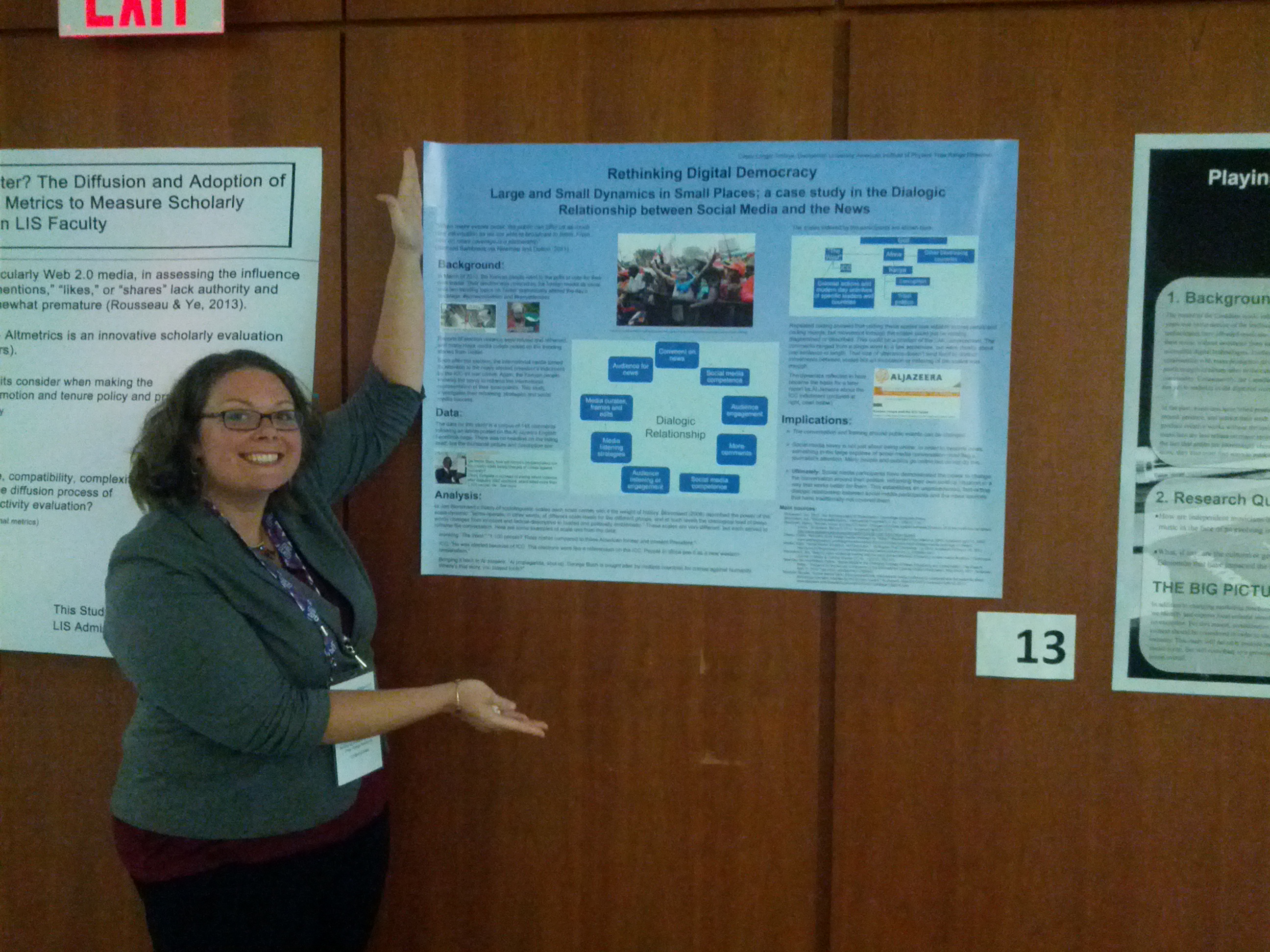
I presented this poster: Rethinking Digital Democracy v4 at the Social Media and Society conference last weekend, and it demonstrated only one of many images of digital democracy.

Digital democracy was portrayed at this conference as:

having a voice in the local public square (Habermas)

making local leadership directly accountable to constituents

having a voice in an external public sphere via international media sources

coordinating or facilitating a large scale protest movement

the ability to generate observable political changes

political engagement and/or mobilization

a working partnership between citizenry, government and emergency responders in crisis situations

a systematic archival of government activity brought to the public eye. “Archives can shed light on the darker places of the national soul”(Wilson 2012)

One presenter had the most systematic representation of digital democracy. Regarding the recent elections in Nigeria, he summarized digital democracy this way: “social media brought socialization, mobilization, participation and legitimization to the Nigerian electoral process.”
Not surprisingly, different working definitions brought different measures. How do you know that you have achieved digital democracy? What constitutes effective or successful digital democracy? And what phenomena are worthy of study and emulation? The scope of this question and answer varies greatly among some of the examples raised during the conference, which included:

citizens in the recent Nigerian election

citizens who tweet during a natural disaster or active crisis situation

citizens who changed the international media narrative regarding the recent Kenyan elections and ICC indictment

Arab Spring actions, activities and discussions
“The power of the people of greater than the people in power” a perfect quote related to Arab revolutions on a slide from Mona Kasra

the recent Occupy movement in the US

tweets to, from and about the US congress

and many more that I wasn’t able to catch or follow…

In the end, I don’t have a suggestion for a working definition or measures, and my coverage here really only scratches the surface of the topic. But I do think that it’s helpful for people working in the area to be aware of the variety of events, people, working definitions and measures at play in wider discussions of digital democracy. Here are a few question for researchers like us to ask ourselves:

What phenomenon are we studying?

How are people acting to affect their representation or governance?

Why do we think of it as an instance of digital democracy?

Who are “the people” in this case, and who is in a position of power?

What is our working definition of digital democracy?

Under that definition, what would constitute effective or successful participation? Is this measurable, codeable or a good fit for our data?

Is this a case of internal or external influence?

And, for fun, a few interesting areas of research:

There is a clear tension between the ground-up perception of the democratic process and the degree of cohesion necessary to affect change (e.g. Occupy & the anarchist framework)

Erving Goffman’s participant framework is also further ground for research in digital democracy (author/animator/principal <– think online petition and e-mail drives, for example, and the relationship between reworded messages, perceived efficacy and the reception that the e-mails receive).

It is clear that social media helps people have a voice and connect in ways that they haven’t always been able to. But this influence has yet to take any firm shape either among researchers or among those who are practicing or interested in digital democracy.

I found this tweet particularly apt, so I’d like to end on this note:

“Direct democracy is not going to replace representative government, but supplement and extend representation” #YES #SMSociety13

— Ray MacLeod (@RayMacLeod) September 14, 2013


Reflections on Digital Dualism & Social Media Research from #SMSociety13

I am frustrated by both Digital Dualism and the fight against Digital Dualism.

Digital dualism is the belief that online and offline are different worlds. It shows up relatively harmlessly when someone calls a group of people who are on their devices “antisocial,” but it is much more harmful in the way it pervades the language we use about online communication (e.g. “real” vs. “virtual”).

Many researchers have done important work countering digital dualism. For example, at the recent Social Media & Society conference, Jeffrey Keefer briefly discussed his doctoral work in which he showed that the support that doctoral students offered each other online was both very real and very helpful. I think it’s a shame that anyone ever doubted the power of a social network during such a challenging time, and I’m happy to see that argument trounced! Wooooh, go Jeffrey! (now a well-deserved Dr Keefer!)

Digital dualism is a false distinction, but it is built in part on a distinction that is also very real and very important. Online space and offline spare are different spaces. People can act in either to achieve their goals in very real ways, but, although both are very real, they are very different. The set of qualities with which the two overlap and differ and even blur into each other changes every day. For example, “real name” branding online and GPS enabled in-person gaming across college campuses continue to blur boundaries.

But the private and segmented aspects of online communication are important as well. Sometimes criticism of online space is based on this segmentation, but communities of interest are longstanding phenomena. A book club is expected to be a club for people with a shared interest in books. A workplace is a place for people with shared professional interests. A swim team is for people who want to swim together. And none of these relationships would be confused with the longstanding close personal relationships we share with friends and family. When online activities are compared with offline ones, often people are falsely comparing interest related activities online with the longstanding close personal ties we share with friends and family. In an effort to counter this, some have take moves to make online communication more unified and holistic. But they do this at the expense of one of the greatest strengths of online communication.

Let’s discuss my recent trip to Halifax for this conference as an example.

My friends and family saw this picture:

Voila! Rethinking Digital Democracy! More of a "Hey mom, here's my poster!" shot than a "Read and engage with my argument!" shot

Voila! Rethinking Digital Democracy! More of a “Hey mom, here’s my poster!” shot than a “Read and engage with my argument!” shot

My dad saw this one:

Not bad for airport fare, eh?

Not bad for airport fare, eh?

This picture showed up on Instagram:

2013-09-16 15.27.43

It’s a glass wall, but it looks like water!

People on Spotify might have followed the music I listened to, and people on Goodreads may have followed my inflight reading.

My Twitter followers and those following the conference online saw this:

Talking about remix culture! Have I landed in heaven? #SMSociety13 #heaveninhalifax #niiice

— Casey Langer Tesfaye (@FreeRangeRsrch) September 15, 2013

And you have been presented with a different account altogether

This fractioning makes sense to me, because I wouldn’t expect any one person to share this whole set of interests. I am able to freely discuss my area of interest with others who share the same interests.

Another presenter gave an example of LGBT youth on Facebook. The lack of anonymity can make it very hard for people who want to experiment or speak freely about a taboo topic to do so without it being taken out of context. Private and anonymous spaces that used to abound online are increasingly harder to find.

In my mind this harkens back a little to the early days of social media research, when research methods were deeply tied to descriptions of platforms and online activity on them. As platforms rose and fell, this research was increasingly useless. Researchers had to move their focus to online actions without trying to route them in platform or offline activity. Is social media research being hindered in similar ways, by answering old criticisms instead of focusing on current and future potential?  Social media needs to move away from these artificial roots. Instead of countering silly claims about social media being antisocial or anything more than real communication, we should focus our research activities on the ways in which people communicate online and the situated social actions and behaviors in online situations. This means, don’t try to ferret out people from usernames, or sort out who is behind a username. Don’t try to match across platforms. Don’t demand real names.

Honestly, anyone who is subjected to social feeds that contain quite a bit of posts outside their area of interest should be grateful to refocus and move on! People of abstract Instagram should be thrilled not to have seen a bowl of seafood chowder, and my family and friends should be thrilled not to have to hear me ramble on about digital dualism or context collapse!

I would love to discuss this further. If you’ve been waiting to post a comment on this blog, this is a great time for you to jump in and join the conversation!