Deeper into the family files; recipes and gendered histories

One picture of my mom really captures me. It is of my parents at a political event, greeting George Will. My mother was heavily involved in politics, and she had likely been one of the event’s organizers, partially responsible for bringing George Will to town. She has a huge smile, and her eyes are sparkling. She is focused on George Will. But George Will is not even looking in her direction. He’s greeting my father, who likely had nothing to do with the event.

The deeper I look into the family files, the deeper my understanding of my mother’s particular brand of feminism grows.

As I grew into a woman, she was proud of me for many reasons, but she never came to grips with my love of cooking. She hated cooking with a passion, and she treated kitchens like they held hostages, like they had latch stations at their gates that clicked into place around unsuspecting ankles as they crossed the threshold. She was a great cook. She created souffles with ease. But she hated the kitchen and hated to see me cook. In fact, I learned to cook against her will, once I’d left home for college. In our lives together we shared many activities, but we never cooked together. She never shared a recipe with me. Granted, I didn’t push. I am a vegetarian, bent on healthy cooking and vegan substitutions, and she was a part of a sour cream generation.

Her kitchen history came alive in a wholly different way as I sorted through her papers. I found boxes, books, clippings and handwritten recipes. I’d seen all of these often in my youth, but I’d never looked through them. As I looked through them now, a new kind of culture began to take shape. These recipes weren’t the anonymous instructions that I find on the internet when I search. They had histories. They belonged to the women that created them. They gave credit to any creative twist on the old standards. They seemed as unique as footprints. And they were clearly passed around quite a bit. I imagined my mom tasting something delicious at a friend’s house and asking for the recipe, and I imagined the pride that the cook had felt in that moment. I can imagine moments like these, but they seem incongruous, deeply out of character for all involved.

Cooking is not simply about our need to fuel our bodies. And it’s a different process for my husband to cook (he loves to cook and has a professional cooking background) than it is for me. My time in the kitchen is part of a deeply gendered history. It is heavy with expectations, ideals and predefined roles. Maybe this is why I avoid recipes? Following a recipe seems to be about creating an ideal and trying to embody it. It’s about believing in your potential to make some fantasy a reality for your family. It’s about embodying a role that has been laid before you. It’s about achieving an unrealistic standard. A successful dish isn’t just food for the belly or a pleasant taste. It’s a sense of accomplishment, a sense of pride, a sense of achievement. It’s about the success of the cook and the nurturing of those around the cook. It connects a woman to a greater tradition of women in the kitchen.

In our histories, people are pegged into traditional societal roles that they may or may not fit into easily. One one hand, they are held back from other roles and relegated to these. But on the other hand, they embody these roles in a way that rises above the call of duty.

These traditions embody uniqueness, a common respect and understanding, a kind of sisterhood, and a common striving. My mom hated the kitchen. But she was a part of a sisterhood that I’m discovering as more of a historian than a participant. Would I trade my professional or academic success for that sisterhood? Absolutely not. But as a woman in the kitchen, I want to understand what these traditions meant to the women who came before me. I want to understand how they redefined them and rose above them. I want to understand how they fit themselves and the women around them into these roles.

I will pass these recipes on to my daughters- not as instructions for cooking or instructions for life, but as a way of carrying on a sisterhood forged by the women who came before us.

I recently accomplished my first successful omelet!

I recently accomplished my first successful omelet!

For further (& really interesting) reading: http://www.presenttensejournal.org/vol1/cooking-codes-cookbook-discourses-as-womens-rhetorical-practices/

Upcoming DC Event: Online Research Offline Lunch

ETA: Registration for this event is now CLOSED. If you have already signed up, you will receive a confirmation e-mail shortly. Any sign-ups after this date will be stored as a contact list for any future events. Thank you for your interest! We’re excited to gather with such a diverse and interesting group.

—–

Are you in or near the DC area? Come join us!

Although DC is a great meeting place for specific areas of online research, there are few opportunities for interdisciplinary gatherings of professionals and academics. This lunch will provide an informal opportunity for a diverse set of online researchers to listen and talk respectfully about our interests and our work and to see our endeavors from new, valuable perspectives.

Date & Time: August 6, 2013, 12:30 p.m.

Location: Near Gallery Place or Metro Center. Once we have a rough headcount, we’ll choose an appropriate location. (Feel free to suggest a place!)

Please RSVP using this form:

Go back

Your message has been sent

Warning
Warning
Warning
Warning

Warning.

Spam, Personal histories and Language competencies

Over the recent holiday, I spent some time sorting through many boxes of family memorabilia. Some of you have probably done this with your families. It is fascinating, sentimental and mind-boggling. Highlights include both the things that strike a chord and things that can be thrown away. It’s a balance of efficiency and sap.


I’m always amazed by the way family memorabilia tells both private, personal histories and larger public ones. The boxes I dealt with last week were my mom’s, and her passion was politics. Even the Christmas cards she saved give pieces of political histories. Old thank you cards provide unknown nuggets of political strategy. She had even saved stirrers and plastic cups from an inauguration!


Campaign button found in the family files

Campaign button found in the family files


My mom continued to work in politics throughout her life, but the work that she did more recently is understandably fresher and more tangible for me. I remember looking through printed Christmas cards from politicians and wondering why she held on to them. In her later years I worried about her tendency to hold on to mail merged political letters. I wondered if her tendency to personalize impersonal documents made her vulnerable to fraud. To me, her belief in these documents made no sense.


Flash forward one year to me sorting through boxes of handwritten letters from politicians that mirror the spam she held on to. For many years she received handwritten letters from elected politicians in Washington. At some point, the handwritten letters evolved into typed letters that were hand-corrected and included handwritten sections. These evolved into typed letters on which the only handwriting was the signature. Eventually, even the signatures became printed. But the intention and function of these letters remained the same, even as their typography evolved. She believed in these letters because she had been receiving them for many decades. She believed they were personal because she had seen more of them that were personal than not. The phrases that I believe to be formulaic and spammy were once handwritten, intentional, personal and probably even heartfelt.


There are a few directions I could go from here:


– I better understand why older people complain about the impersonalization of modern society and wax poetic about the old letter writing tradition. I could include a few anecdotes about older family members.


– I’m amazed that people would take the time to write long letters using handwriting that may never have been deciphered


– I could wax poetic about some of the cool things I found in the storage facility


But I won’t. Not in this blog. Instead, I’ll talk about competencies.


Spam is a manifest of language competencies, although we often dismiss it as a total lack of language competence. In my Linguistics study, we were quickly taught the mantra “difference, not deficiency.” In fact it takes quite a bit of skill to develop spam letters. In survey research, the survey invitation letters that people so often dismiss have been heavily researched and optimized to yield a maximum response rate. In his book The Sociolinguistics of Globalization, Jan Blommaert details the many competencies necessary to create the Nigerian bank scam letters that were so heavily circulated a few years ago. And now I’ve learned that the political letters that I’m so quick to dismiss as thoughtless mail merges are actually part of a deep tradition of political action. Will that be enough for me to hold on to them? No. But I am saving the handwritten stuff. Boxes and boxes of it!


One day last week, as I drove to the storage facility I heard an interview with Michael Pollan about Food Literacy. Pollan’s point was that the food draughts in some urban areas are not just a function of access (Food draughts are areas where fresh food is difficult to obtain and grocery stores are few and far between, if they’re available at all). Pollan believes that even if there were grocery stores available, the people in these neighborhoods lack the basic cooking skills to prepare the food. He cited a few basic cooking skills which are not basic to me (partly because I’m a vegetarian, and partly because of the cooking traditions I learned from) as a part of his argument.


As a linguist, it is very interesting to hear the baggage that people attach to language metaphorically carried over to food (“food illiteracy”). I wonder what value the “difference, not deficiency” mantra holds here. I’m not ready to believe that people in areas subject to food draught are indeed kitchen illiterate. But I wouldn’t hesitate to agree that their food cultures probably differ significantly from Pollan’s. The basic staples and cooking methods probably differ significantly. Pollan could probably make a lot more headway with his cause if, instead of assuming that the people he is trying to help lack any basic cooking skills, he advocated toward a culture change that included access, attainability, and the potential to learn different practical cooking skills. It’s a subtle shift, but an important one.


As a proud uncook, I’m a huge fan of any kind of food preparation that is two steps or less, cheap, easy and fresh. Fast food for me involves putting a sweet potato in the microwave and pressing “potato,” grabbing for an apple or carrots and peanut butter, or tossing chickpeas into a dressing. Slow food involves the basic sautéing, roasting, etc. that Pollan advocates. I imagine that the skills he advocates are more practical and enjoyable for him than they are for people like me, whose mealtimes are usually limited and chaotic. What he calls basic is impractical for many of us. And the differences in time and money involved in uncooking and “basics” add up quickly.


So I’ve taken this post in quite a few directions, but it all comes together under one important point. Different language skills are not a lack of language skills altogether. Similarly, different survival skills are not a total lack of survival skills. We all carry unique skillsets that reflect our personal histories with those skills as well as the larger public histories that our personal histories help to compose. We, as people, are part of a larger public. The political spam I see doesn’t meet my expectations of valuable, personal communication, but it is in fact part of a rich political history. The people who Michael Pollan encounters have ways of feeding themselves that differ from Pollan’s expectations, but they are not without important survival skills. Cultural differences are not an indication of an underlying lack of culture.

2013-07-05 11.13.21


Fitness for Purpose, Representativeness and the perils of online reviews

Have you ever planned a trip online? In January, when I traveled to Amsterdam, I did all of the legwork online and ended up in a surprising place.

Amsterdam City Center is extremely easy to navigate. From the train station (a quick ride from the airport and a quick ride around The Netherlands), the canals extend outward like spokes. Each canal is flanked by streets. Then the city has a number of concentric rings emanating from the train station. Not only is the underlying map easy to navigate, there is a traveler station at the center and maps available periodically. English speaking tourists will see that not only do many people speak English, but Dutch has enough overlap with English to be comprehensible after even a short exposure.

But the city center experience was not as smooth for me. I studied map after map in the city center without finding my hotel. I asked for directions, and no one had heard of the hotel or the street it was on. The traveler center seemed flummoxed as well. Eventually I found someone who could help and found myself on a long commuter tram ride well outside the city center and tourist areas. The hotel had received great reviews and recommendations from many travelers. But clearly, the travelers who boasted about it were not quite the typical travelers, who likely would have ended up in one of the many hotels I saw from the tram window.

Have you ever discovered a restaurant online? I recently went to a nice, local restaurant that I’d been reading about for years. I ordered the truffle fries (fries with truffle salt and some kind of fondue sauce), because people had really raved about them, only to discover once they arrived that they were fundamentally french fries (totally not my bag- I hate fried food).

These review sites are not representative of anything. And yet we/I repeatedly use them as if they were reliable sources of information. One could easily argue that they may not be representative, but they are good enough for their intended use (fitness for purpose <– big, controversial notion from a recent AAPOR task force report on Nonprobability Sampling). I would argue that they are clearly not excellent for their intended use. But does that invalidate them altogether? They often they provide the only window that we have into the whatever it is that we intend them for.

Truffle fried aside, the restaurant was great. And location aside, the hotel was definitely an interesting experience.

Toilet capsule in hotel room (with frosted glass rotating pane for some degree of privacy)

Toilet capsule in hotel room (with frosted glass rotating pane for some degree of privacy)

Representativeness, qual & quant, and Big Data. Lost in translation?

My biggest challenge in coming from a quantitative background to a qualitative research program was representativeness. I came to class firmly rooted in the principle of Representativeness, and my classmates seemed not to have any idea why it mattered so much to me. Time after time I would get caught up in my data selection. I would pose the wider challenge of representativeness to a colleague, and they would ask “representative of what? why?”


In the survey research world, the researcher begins with a population of interest and finds a way to collect a representative sample of the population for study. In the qualitative world that accompanies survey research units of analysis are generally people, and people are chosen for their representativeness. Representativeness is often constructed by demographic characteristics. If you’ve read this blog before, you know of my issues with demographics. Too often, demographic variables are used as a knee jerk variable instead of better considered variables that are more relevant to the analysis at hand. (Maybe the census collects gender and not program availability, for example, but just because a variable is available and somewhat correlated doesn’t mean that it is in fact a relevant variable, especially when the focus of study is a population for whom gender is such an integral societal difference.)


And yet I spent a whole semester studying 5 minutes of conversation between 4 people. What was that representative of? Nothing but itself. It couldn’t have been exchanged for any other 5 minutes of conversation. It was simply a conversation that this group had and forgot. But over the course of the semester, this piece of conversation taught me countless aspects of conversation research. Every time I delved back into the data, it became richer. It was my first step into the world of microanalysis, where I discovered that just about anything can be a rich dataset if you use it carefully. A snapshot of people at a lecture? Well, how are their bodies oriented? A snapshot of video? A treasure trove of gestures and facial expressions. A piece of graffiti? Semiotic analysis! It goes on. The world of microanalysis is built on the practice of layered noticing. It goes deeper than wide.


But what is it representative of? How could a conversation be representative? Would I need to collect more conversations, but restrict the participants? Collect conversations with more participants, but in similar contexts? How much or how many would be enough?


In the world of microanalysis, people and objects constantly create and recreate themselves. You consistently create and recreate yourself, but your recreations generally fall into a similar range that makes you different from your neighbors. There are big themes in small moments. But what are the small moments representative of? Themselves. Simply, plainly, nothing more and nothing else. Does that mean that they don’t matter? I would argue that there is no better way to understand the world around us in deep detail than through microanalysis. I would also argue that macroanalysis is an important part of discovering the wider patterns in the world around us.


Recently a NY Times blog post by Quentin Hardy has garnered quite a bit of attention.

Why Big Data is Not Truth: http://bits.blogs.nytimes.com/2013/06/01/why-big-data-is-not-truth/

This post has really struck a chord with me, because I have had a hard time understanding Hardy’s complaint. Is big data truth? Is any data truth? All data is what it is; a collection of some sort, collected under a specific set of circumstances. Even data that we hope to be more representative has sampling and contextual limitations. Responsible analysts should always be upfront about what their data represents. Is big data less truthful than other kinds of data? It may be less representative than, say, a systematically collected political poll. But it is what it is: different data, collected under different circumstances in a different way. It shouldn’t be equated with other data that was collected differently. One true weakness of many large scale analyses is the blindness to the nature of the data, but that is a byproduct of the training algorithms that are used for much of the analysis. The algorithms need large training datasets, from anywhere. These sets often are developed through massive web crawlers. Here, context gets dicey. How does a researcher represent the data properly when they have no idea what it is? Hopefully researchers in this context will be wholly aware that, although their data has certain uses, it also has certain [huge] limitations.


I suspect that Hardy’s complaint is with the representations of massive datasets collected from webcrawlers as a complete truth from which any analyses could be run and all of the greater truths of the world could be revealed. On this note, Hardy is exactly right. Data simply is what it is, nothing more and nothing less. And any analysis that focuses on an unknown dataset is just that: an analysis without context. Which is not to say that all analyses need to be representative, but rather that all responsible analyses of good quality need to be self aware. If you do not know what the data represents and when and how it was collected, then you cannot begin to discuss the usefulness of any analysis of it.

The curse of the elevator speech

Yesterday I was involved in an innocent watercooler chat in which I was asked what Sociolinguistics is. This should be an easy enough question, because I just got a master’s degree in it. But it’s not. Sociolinguistics is a large field that means different things to different people. For every way of studying language, there are social and behavioral correlates that can also be studied. So a sociolinguist could focus on any number of linguistic areas, including phonology, syntax, semantics, or, in my case, discourse. My studies focus on the ways in which people use language, and the units of analysis in my studies are above the sentence level. Because Linguistics is such a large and siloed field, explaining Sociolinguistics through the lens of discourse analysis feels a bit like explaining vegetarianism through a pescatarian lens. The real vegetarians and the real linguists would balk.

There was a follow up question at the water cooler about y’all. “Is it a Southern thing?” My answer to this was so admittedly lame that I’ve been trying to think of a better one (sometimes even the most casual conversations linger, don’t they?).

My favorite quote of this past semester was from Jan Blommaert: “Language reflects a life, and not just a birth, and it is a life that is lived in a real sociocultural, historical and political space” Y’all has long been considered a southernism, but when I think back to my own experience with it, it was never about southern language or southern identity. One big clue to this is that I do sometimes use y’all, but I don’t use other southern language features along with it.

If I wanted to further investigate y’all from a sociolinguistic perspective, I would take language samples, either from one or a variety of speakers (and this sampling would have clear, meaningful consequences) and track the uses of y’all to see when it was invoked and what function it serves when invoked. My best, uninformed guess is that it does relational work and invokes registers that are more casual and nonthreatening. But without data, that is nothing but an uninformed guess.

This work has likely been done before. It would be interesting to see.
(ETA: Here is an example of this kind of work in action, by Barbara Johnstone)

What is the role of Ethnography and Microanalysis in Online Research?

There is a large disconnect in online research.

The largest, most profile, highest value and most widely practiced side of online research was created out of a high demand to analyze the large amount of consumer data that is constantly being created and largely public available. This tremendous demand led to research methods that were created in relative haste. Math and programming skills thrived in a realm where social science barely made a whisper. The notion of atheoretical research grew. The level of programming and mathematical competence required to do this work continues to grow higher every day, as the fields of data science and machine learning become continually more nuanced.

The largest, low profile, lowest value and increasingly more practiced side of online research is the academic research. Turning academia toward online research has been like turning a massive ocean liner. For a while online research was not well respected. At this point it is increasingly well respected, thriving in a variety of fields and in a much needed interdisciplinary way, and driven by a search for a better understanding of online behavior and better theories to drive analyses.

I see great value in the intersection between these areas. I imagine that the best programmers have a big appetite for any theory they can use to drive their work in a useful and productive ways. But I don’t see this value coming to bear on the market. Hiring is almost universally focused on programmers and data scientists, and the microanalytic work that is done seems largely invisible to the larger entities out there.

It is common to consider quantitative and qualitative research methods as two separate languages with few bilinguals. At the AAPOR conference in Boston last week, Paul Lavarakas mentioned a book he is working on with Margaret Roller which expands the Total Survey Error model to both quantitative and qualitative research methodology. I spoke with Margaret Roller about the book, and she emphasized the importance of qualitative researchers being able to talk more fluently and openly about methodology and quality controls. I believe that this is, albeit a huge challenge in wording and framing, a very important step for qualitative research, in part because quality frameworks lend credibility to qualitative research in the eyes of a wider research community. I wish this book a great deal of success, and I hope that it is able to find an audience and a frame outside the realm of survey research (Although survey research has a great deal of foundational research, it is not well known outside of the field, and this book will merit a wider audience).

But outside of this book, I’m not quite sure where or how the work of bringing these two distinct areas of research can or will be done.

Also at the AAPOR conference last week, I participated in a panel on The Role of Blogs in Public Opinion Research (intro here and summary here). Blogs serve a special purpose in the field of research. Academic research is foundational and important, but the publish rate on papers is low, and the burden of proof is high. Articles that are published are crafted as an argument. But what of the bumps along the road? The meditations on methodology that arise? Blogs provide a way for researchers to work through challenges and to publish their failures. They provide an experimental space where fields and ideas can come together that previously hadn’t mixed. They provide a space for finding, testing, and crossing boundaries.

Beyond this, they are a vehicle for dissemination. They are accessible and informally advertised. The time frame to publish is short, the burden lower (although I’d like to believe that you have to earn your audience with your words). They are a public face to research.

I hope that we will continue to test these boundaries, to cross over barriers like quantitative and qualitative that are unhelpful and obtrusive. I hope that we will be able to see that we all need each other as researchers, and the quality research that we all want to work for will only be achieved through the mutual recognition that we need.

Digital Democracy Remixed

I recently transitioned from my study of the many reasons why the voice of DC taxi drivers is largely absent from online discussions into a study of the powerful voice of the Kenyan people in shaping their political narrative using social media. I discovered a few interesting things about digital democracy and social media research along the way, and the contrast between the groups was particularly useful.

Here are some key points:

  • The methods of sensemaking that journalists use in social media is similar to other methods of social media research, except for a few key factors, the most important of which is that the bar for verification is higher
  • The search for identifiable news sources is important to journalists and stands in contrast with research methods that are built on anonymity. This means that the input that journalists will ultimately use will be on a smaller scale than the automated analyses of large datasets widely used in social media research.
  • The ultimate information sources for journalists will be small, but the phenomena that will capture their attention will likely be big. Although journalists need to dig deep into information, something in the large expanse of social media conversation must capture or flag their initial attention
  • It takes some social media savvy to catch the attention of journalists. This social media savvy outweighs linguistic correctness in the ultimate process of getting noticed. Journalists act as intermediaries between social media participants and a larger public audience, and part of the intermediary process is language correcting.
  • Social media savvy is not just about being online. It is about participating in social media platforms in a publicly accessible way in regards to publicly relevant topics and using the patterned dialogic conventions of the platform on a scale that can ultimately draw attention. Many people and publics go online but do not do this.

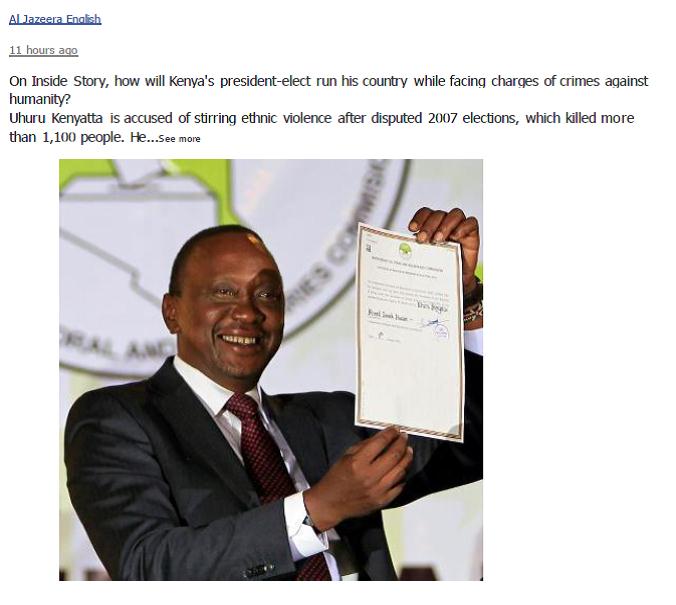
The analysis of social media data for this project was particularly interesting. My data source was the comments following this posting on the Al Jazeera English Facebook feed.

fb

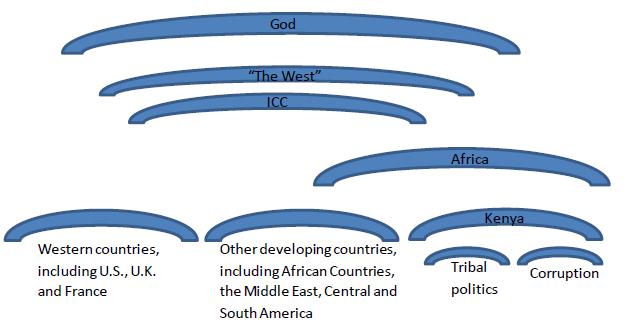
It evolved quite organically. After a number of rounds of coding I noticed that I kept drawing diagrams in the margins of some of the comments. I combined the diagrams into this framework:

scales

Once this framework was built, I looked closely at the ways in which participants used this framework. Sometimes participants made distinct discursive moves between these levels. But when I tried to map the participants’ movements on their individual diagrams, I noticed that my depictions of their movements rarely matched when I returned to a diagram. Although my coding of the framework was very reliable, my coding of the movements was not at all. This led me to notice that oftentimes the frames were being used more indexically. Participants were indexing levels of the frame, and this indexical process created powerful frame shifts. So, on the level of Kenyan politics exclusively, Uhuru’s crimes had one meaning. But juxtaposed against the crimes of other national leaders’ Uhuru’s crimes had a dramatically different meaning. Similarly, when the legitimacy of the ICC was questioned, the charges took on a dramatically different meaning. When Uhuru’s crimes were embedded in the postcolonial East vs West dynamic, they shrunk to the degree that the indictments seemed petty and hypocritical. And, ultimately, when religion was invoked the persecution of one man seemed wholly irrelevant and sacrilegious.

These powerful frame shifts enable the Kenyan public to have a powerful, narrative changing voice in social media. And their social media savvy enables them to gain the attention of media sources that amplify their voices and thus redefine their public narrative.

readyforcnn

Instagram is changing the way I see

I recently joined Instagram (I’m late, I know).

I joined because my daughter wanted to, because her friends had, to see what it was all about. She is artistic, and we like to talk about things like color combinations and camera angles, so Instagram is a good fit for us. But it’s quickly changing the way I understand photography. I’ve always been able to set up a good shot, and I’ve always had an eye for color. But I’ve never seriously followed up on any of it. It didn’t take long on Instagram to learn that an eye for framing and color is not enough to make for anything more than accidental great shots. The great shots that I see are the ones that pick deeper patterns or unexpected contrasts out of seemingly ordinary surroundings. They don’t simply capture beauty, they capture an unexpected natural order or a surprising contrast, or they tell a story. They make you gasp or they make you wonder. They share a vision, a moment, an insight. They’re like the beginning paragraph of a novel or the sketch outline of a poem. Realizing that, I have learned that capturing the obvious beauty around me is not enough. To find the good shots, I’ll need to leave my comfort zone, to feel or notice differently, to wonder what or who belongs in a space and what or who doesn’t, and why any of it would capture anyone’s interest. It’s not enough to see a door. I have to wonder what’s behind it. To my surprise, Instagram has taught me how to think like a writer again, how to find hidden narratives, how to feel contrast again.

Sure this makes for a pretty picture. But what is unexpected about it? Who belongs in this space? Who doesn't? What would catch your eye?

Sure this makes for a pretty picture. But what is unexpected about it? Who belongs in this space? Who doesn’t? What would catch your eye?

This kind of change has a great value, of course, for a social media researcher. The kinds of connections that people forge on social media, the different ways in which people use platforms and the ways in which platforms shape the way we interact with the world around us, both virtual and real, are vitally important elements in the research process. In order to create valid, useful research in social media, the methods and thinking of the researcher have to follow closely with the methods and thinking of the users. If your sensemaking process imitates the sensemaking process of the users, you know that you’re working in the right direction, but if you ignore the behaviors and goals of the users, you have likely missed the point altogether. (For example, if you think of Twitter hashtags simply as an organizational scheme, you’ve missed the strategic, ironic, insightful and often humorous ways in which people use hashtags. Or if you think that hashtags naturally fall into specific patterns, you’re missing their dialogic nature.)

My current research involves the cycle between social media and journalism, and it runs across platforms. I am asking questions like ‘what gets picked up by reporters and why?’ and ‘what is designed for reporters to pick up?’ And some of these questions lead me to examine the differences between funny memes that circulate like wildfire through Twitter leading to trends and a wider stage and the more indepth conversation on public facebook pages, which cannot trend as easily and is far less punchy and digestible. What role does each play in the political process and in constituting news?

Of course, my current research asks more questions than these, but it’s currently under construction. I’d rather not invite you into the workzone until some of the pulp and debris have been swept aside…

Still grappling with demographics

Last year I wrote about my changing perspective on demographic variables. My grappling has continued since then.
I think of it as an academic puberty of sorts.

I remember the many crazy thought exercises I subjected myself to as a teenager, as I tried to forge my own set of beliefs and my own place in the world. I questioned everything. At times I was under so much construction that it was a wonder I functioned at all. Thankfully, I survived to enter my twenties intact. But lately I have been caught in a similar thought exercise of sorts, second guessing the use of sociological demographic variables in research.

Two sample projects mark two sides of the argument. One is a potential study of the climate for underrepresented faculty members in physics departments. In our exploration of this subject, the meaning of underrepresented was raised. Indeed there are a number of ways in which a faculty member could be underrepresented or made uncomfortable: gender, race, ethnicity, accent, bodily differences or disabilities, sexual orientation, religion, … At some point, one could ask whether it matters which of these inspired prejudicial or different treatment, or whether the hostile climate is, in and of itself, important to note. Does it make sense to tick off which of a set of possible prejudices are stronger or weaker at a particular department? Or does it matter first that the uncomfortable climate exists, and that personal differences that should be professionally irrelevant are coming into professional play. One could argue that the climate should be the first phase of the study, and any demographics could be secondary. One might be particularly tempted to argue for this arrangement given the small sizes of the departments and hesitation among many faculty members to supply information that could identify them personally.

If that was the only project on my mind, I might be tempted to take a more deconstructionist view of demographic variables altogether. But there is another project that I’m working on that argues against the deconstructionist view- the Global Survey of Physicists.

(Side or backstory: The global survey is kind of a pet project of mine, and it was the project that led me to grad school. Working on it involved coordinating survey design, translation and dissemination with representatives from over 100 countries. This was our first translation project. It began in English and was then translated into 7 additional languages. The translation process took almost a full year and was full of unexpected complications. Near the end of this phase, I attended a talk at the Bureau of Labor Statistics by Yuling Pan from Census. The talk was entitled ‘the Sociolinguistics of Survey Translation.’ I attended it never having heard of Sociolinguistics before. During the course of the talk, Yuling detailed and dissected experiences that paralleled my own into useful pieces and diagnosed and described some of the challenges I had encountered in detail. I was so impressed with her talk that I googled Sociolinguistics as soon as I returned to my office, discovered the MLC a few minutes later. One month later I was visiting Georgetown and working on my application for the MLC. I like to say it was like being swept up off my feet and then engaging in a happy shotgun marriage)

The Global Survey was designed to elicit gender differences in terms of experiences, climate, resources and opportunities, as well as the effects of personal and family constraints and decisions on school and career. The survey worked particularly well, and each dive into the data proves fascinating. This week I delved deeper into the dynamics of one country and saw women’s sources of support erode as they progressed further into school and work, saw the women transition from a virtual parity in school to difficult careers, beginning with their significantly larger chance of having to choose their job because it was the only offer they received, and becoming significantly worse with the introduction of kids. In fact, we found through this survey that kids tend to slow women’s careers and accelerate men’s!

What do these findings say about the use of demographic variables? They certainly validate their usefulness and cause me to wonder whether a lack of focus on demographics would lessen the usefulness of the faculty study. Here I’m reminded that it is important, when discussing demographic variables, to keep in mind that they are not arbitrary. They reflect ways of seeing that are deeply engrained in society. Gender, for example, is the first thing to note about a baby, and it determines a great deal from that point in. Excluding race or ethnicity seems foolish, too, in a society that so deeply engrains these distinctions.

The problem may be in the a priori or unconsidered applications of demographic variables. All too often, the same tired set of variables are dredged up without first considering whether they would even provide a useful distinction or the most useful cuts to a dataset. A recent example of this is the study that garnered some press about racial differences in e-learning. From what I read of the study, all e-learning was collapsed into a single entity, an outcome or dependent variable (as in some kind if measure of success of e-learning), and run by a set of traditional x’s or independent variables, like race and socioeconomic status. In this case, I would have preferred to first see a deeper look into the mechanics of e-learning than a knee jerk rush to the demographic variables. What kind of e-learning course was it? What kinds of interaction were fostered between the students and the teacher, material and other students? So many experiences of e-learning were collapsed together, and differences in course types and learning environments make for more useful and actionable recommendations than demographics ever could.

In the case of the faculty and global surveys as well, one should ask what approaches to the data would yield the most useful analyses. Finding demographic differences leads to what- an awareness of discrimination? Discrimination is deep seeded and not easily cured. It is easy to document and difficult to fix. And yet, more specific information about climate, resources and opportunities could be more useful or actionable. It helps to ask what we can achieve through our research. Are we simply validating or proving known societal differences or are we working to create actionable recommendations? What are the most useful distinctions?

Most likely, if you take the time to carefully consider the information you collect, the usefulness of your analyses and the validity of your hypotheses, you are one step above anyone rotely applying demographic variables out of ill-considered habit. Kudos to you for that!